
The framework calls for a new mechanism to arrest corrupt officials “without tanks” and awaits al-Zaidi’s visit to Washington.
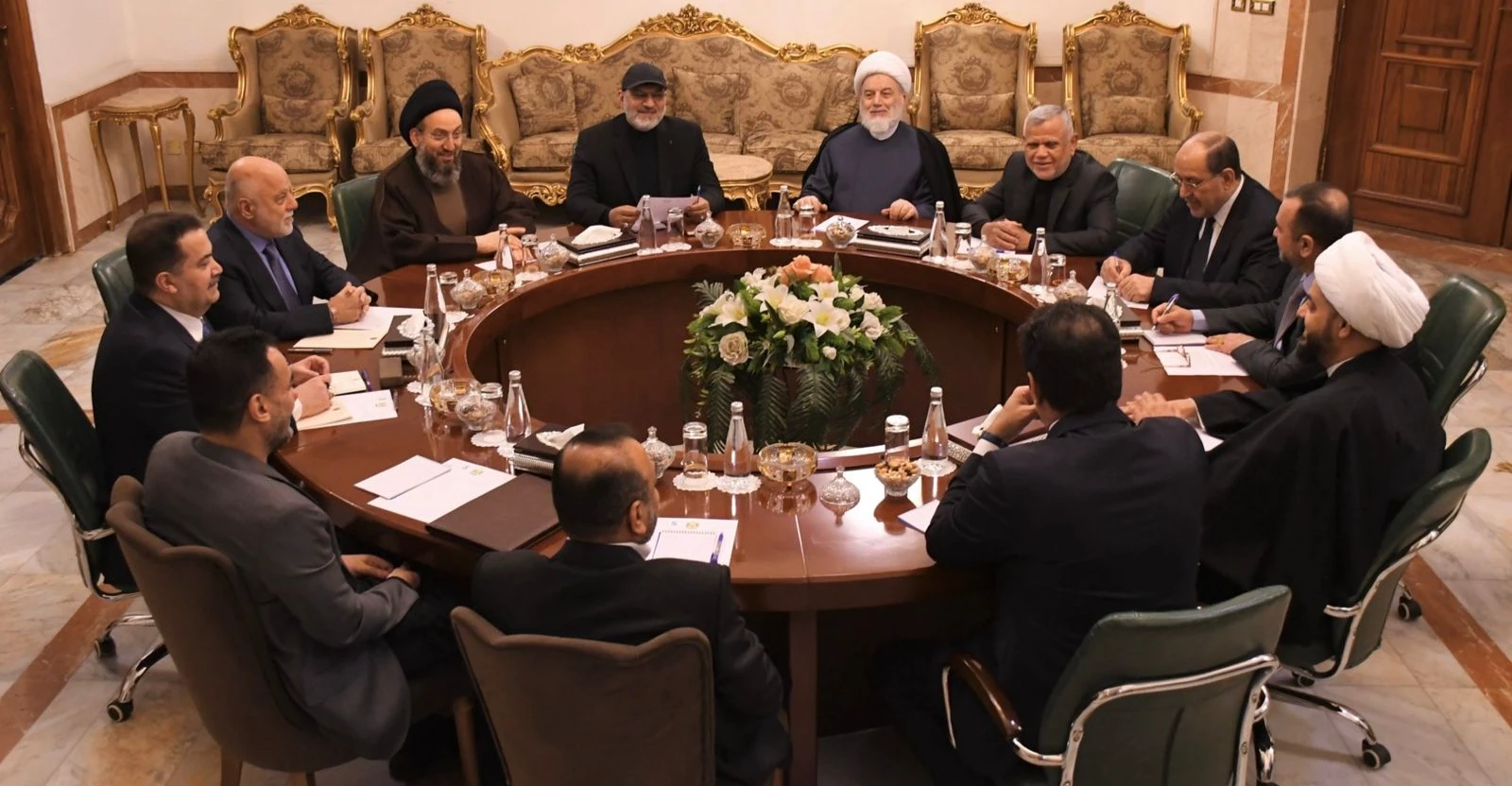 An informed source revealed on Tuesday what transpired between the attendees at the home of Hadi al-Amiri, head of the Badr Organization, indicating that they focused on adopting a new mechanism for summoning those involved in suspected financial corruption, away from “tanks and security forces,” while pinning their hopes on Prime Minister Ali al-Zubaidi’s visit to Washington.
The source told Shafaq News Agency that “those gathered stressed the need for summoning those involved in suspected corruption and squandering of public funds to be done through official reports issued by the judiciary, without using security or military force, and without concealing information related to the ongoing investigations with detainees within the ‘Dawn Campaign’ to combat corruption, which is led and supervised by Prime Minister Ali al-Zaidi . ”
He added: “It was also emphasized that investigations with the detainees will be completed and matched with the facts, and that funds smuggled or acquired illegally will be recovered.”
The source indicated that “some political leaders expressed their displeasure with the information being circulated about the nature of the investigations and the funds to be recovered, and that all the leaders of the framework pledged to Al-Zidi to continue supporting the government’s measures in combating corruption and to support him in issuing red notices for the extradition of wanted persons who are outside Iraq.” Politics
Regarding the red notices, the attendees stressed, according to the source, that the notices should be issued by the Ministry of Justice, since most international agreements regarding the extradition of wanted persons involved in financial corruption crimes stipulate that arrest warrants be issued by the Ministry of Justice and not by the Iraqi Judicial Council.
He revealed that there are “five countries that have shown cooperation with Iraq in this field and handed over wanted persons or those proven to be involved in the crimes attributed to them through Interpol International, namely the United States, France, Britain, and only one Arab country,” without the source naming the Arab country or the fifth country.
The meeting also touched on the electoral process and the remaining ministerial appointments, “but all indications point towards postponing the decision until after al-Zidi’s visit to Washington,” according to the source.
He explained that “the State of Law bloc insists on its candidate Qasim Atta for the Ministry of Interior, even though it is about to present six candidates to Al-Zaidi to choose the most suitable among them. Therefore, a specific mechanism will be adopted to decide on the security ministries after Al-Zaidi’s visit to Washington.”
He pointed out that “all political forces are counting on the success of Al-Zaidi’s visit and on achieving great gains for Iraq, including the release of some of the bank transfers held by international banks and the US Federal Reserve, as well as tracking down and recovering the money smuggled out of Iraq, monitoring the whereabouts of those involved, and bringing them back and prosecuting them according to Iraqi law, even if they hold a second nationality or enjoy external support.”
According to the source, the attendees also discussed “finalizing the process of dismantling armed factions and handing over their light and heavy weapons to the state.”
On Monday evening, the Coordination Framework held a meeting at the office of the Secretary-General of the Badr Organization, Hadi al-Amiri, in the presence of the President of the Supreme Judicial Council, Faiq Zaidan, and the Prime Minister, Ali al-Zaidi, according to a statement received by Shafaq News Agency.
The participants discussed the anti-corruption campaign and the cessation of public money waste, and the leaders of the framework, according to the statement, renewed their support for the governmental and judicial measures aimed at combating corruption, stressing the need to proceed with steps that preserve public money and strengthen the rule of law.
Yesterday, Member of Parliament Abdullah Al-Khaigani also revealed that there was an agreement between Prime Minister Ali Al-Zaidi and the head of the Supreme Judicial Council, Faiq Zaidan, to proceed with holding those involved accountable without targeting any political entity at the expense of another.
Al-Khaigani told Shafaq News Agency that “Al-Zaydi, Zaidan, and the security force carrying out the operations agreed to hold corrupt individuals accountable without targeting any party at the expense of another,” indicating that “anti-corruption measures will extend to all Iraqi governorates.”
He added that “the next round of anti-corruption operations will include a large number of defendants, and will be carried out in more than three batches,” explaining that “the measures will affect ministers, directors-general, current and former members of parliament, as well as governors.”
Informed government sources had previously revealed to Shafaq News Agency that the legal procedures for the second phase of the campaign to pursue those involved in corruption cases, which includes files in the Ministries of Health, Oil and Electricity, have been completed. This phase involves tracking funds, real estate and investment projects belonging to officials in the United States, Europe and Turkey, in conjunction with preparing a new list of names of accused persons, as well as studying the draft law “Where did you get this from?” in preparation for completing its legislative course.
Shafaq.com