Al-Kazemi was impressed by the proposals presented by the National Dialogue Conference in Baghdad
 Baghdad – On Friday, Prime Minister Mustafa Al-Kazemi expressed his admiration for the proposals presented during the National Dialogue Conference in Baghdad.
Al-Kazemi stated in a blog post, seen by “Nass” (August 27, 2021), “I was impressed by the proposals presented by the National Dialogue Conference in Baghdad, which included social, professional, cultural and youth figures from all provinces and the reform paper that they voted on.”
He added, “I promised to draw inspiration from the contents of this paper and submit it to the political forces so that it becomes a national pledge and pact that provides an atmosphere of confidence to contest the elections.”
Prime Minister Mustafa Al-Kazemi said, on Thursday, that the people deserve the state, stressing that the time for adventures is over.
Al-Kazemi added, during a speech at the National Dialogue Conference sessions, (August 26, 2021), that “our responsibility is grave, because the main problem in Iraq as we see it was not a problem of demonstrations or the intersection of opinions or ideas, but rather the problem as we understood it is the lack of confidence. And the lack of confidence in any society in the world is a real danger to that society.” He explained, “We have faced a real social crisis, more than just a political crisis, even if its causes are political. When society loses its confidence in official institutions and in the political and electoral process, it is on the verge of losing confidence in the state, and these are the highest stages of danger to any society in the world.”
He continued, “We deeply believe that our people do not lose confidence in the state, so let us understand that the popular movement in Iraq, its essence and depth, is the defense of the state, regardless of the method of expression and the difference in viewing angles on how to practice defending the state.”
Al-Kadhimi affirmed, “We accepted the responsibility according to a road map consisting of three main points: the first is to reach fair, early and early elections.
The second is related to ensuring the security of the citizen and combating uncontrolled weapons. The third is to address the consequences of the painful events that passed through Iraq in the month of October of the year two thousand and nineteen and their repercussions And beyond this history and the fall of dear martyrs from among our youth, while they are demanding their rights.”
And he added, “We focused first on compensating those affected by the families of the October martyrs, and we issued decisions to include them with all the martyrs’ entitlements, and we insisted on this decision despite the presence of political opposition to it, and we did not retreat from taking it to the end.”
He pointed out that “we are still holding on to the election date on the tenth of next October, because we are true to our word before our people. We said in the letter of assignment that we will reach these elections,” saying, “We did our duty and took many steps in terms of supporting the forces and restoring prestige to them to play their role in Protecting the homeland and the citizen and combating uncontrolled weapons and crime, whatever their source.”
He stressed that “the next government must complete this task, and stress the continuation of the momentum to complete building our security and military capabilities and prevent all armed manifestations outside the framework of the state,” stressing that “we are determined to prevent Iraq’s involvement in regional and international quarrels, and we adopted the principles of good neighborliness with our neighbors and friends, and we have prepared Distinguished relations regionally and internationally for the benefit of the Iraqi people.
The Prime Minister pointed out that “the file of foreign relations is at its best for many years, and the Baghdad Conference for Cooperation and Partnership will be held on the soil of Iraq, with broad regional and international participation, which is a reflection of Iraq’s positive foreign policy that opens new doors for cooperation and support for Iraq in all fields, and Iraq restores its size and role.” natural and historical contexts in the regional and international environments.
And he stated, “We formed a legal team of retired judges known for their integrity, which made the greatest stride in collecting facts about the events of October of the year two thousand and nineteen and their repercussions and circumstances from all concerned parties,” noting that “the institutional work of the legal team needs time to ensure its integrity and non-interference.”
In its procedures, we, as a government, left the concerned team absolute freedom to deal with all files related to the executive authority, its institutions, personalities and files, and we also left them absolute freedom to determine the mechanism for announcing the final results of the investigation.
Al-Kazemi stressed that “we faced no less dangerous challenges represented by the economic collapse with the collapse of oil prices, and the challenge of the Corona pandemic, and thank God we have overcome the economic crisis together,” noting that “many parties that do not want good for Iraq did not want us to overcome this crisis, but our people He was vigilant and knew the boundary between the cautious position and the bidding position that traded in the capabilities of the nation, and he realized that the crisis needed real decisions, not political outbidding and shouting in the media.
The Prime Minister said, “We have prepared the reform white paper to be a road map to save the Iraqi economy from the state of slavery in oil prices, and move it to be an effective and productive economy in the coming years,” noting that “what I reviewed here does not represent a defense of the government, and not electoral propaganda; Because, as you know, I am not participating in the elections, but it is a framework that must be clear to understand together the challenges facing this country and the paths that must be established in the next stage.
Al-Kazemi stressed, “I will work hard to ensure that the recommendations of this conference are present in the government’s performance, and I urge all of you to cooperate together as people of one country to move our country from a state of conflict, difference, deterioration, doubts and mistrust to prosperity, development, strength, work and mutual trust.”
He explained that “all these goals do not occur with words only, but through two basic issues: the first is to identify the defect frankly, clearly and courageously. The second is to work to fix this defect, no matter how difficult and painful the matter is, and that we together insist that our people deserve the future and that they deserve to move From chaos to stability.
The Prime Minister said that “our people deserve the state, and reject the non-state, our people deserve their place among the nations of the earth, and refuse to be a playground for conflicts and passions. We must put our hand in the hands of each other, the government and parliament, national political forces, popular activities, clans, youth, women and professional unions, to help our country move forward always, and open future horizons for future generations.”
He stressed that “the time for adventures is over.. Today is our date with hard work, and the elections are the criterion for choosing who will stand up to this work and gain the people’s trust. Participate in the elections and support them. Choose your representatives, and be on the covenant with your people.”
On Thursday, the head of the Independent Research Group, Munqith Dagher, stressed the importance of the outcomes of the “National Dialogue” conference, which is currently being hosted in the capital, Baghdad.
On Thursday, the capital, Baghdad, will witness the activities of the second day of the National Dialogue Conference, with the participation of most of the components, clerics, tribal sheikhs, and academic and patriotic figures from various regions and governorates of Iraq.
Dagher told “Nass” (August 26, 2021), that “the conference has different orientations, aiming for the first time to unify the people’s saying through a written document, as it aims to embody the Iraqi people’s vision, ambition and hopes.”
Dagher pointed out that “the conference turned towards the views of the elites, representatives of the people in general, and activists, rather than towards the opinions of politicians or party activities, with the aim of clarifying the opinion of the Iraqi street on the issues surrounding it.”
The head of the Independent Research Group reiterated in his speech that “the conference wanted to represent the popular forces.”
According to a previous statement to the conference, “Nass” received a copy of it (August 26, 2021), “The goals and message of the National Dialogue Conference included, first, that elections are the primary means of democratic expression, and secondly, the adoption of the constitution, the document that everyone accepted as a governing and just framework, And third, that the political forces in the government and parliament work to ensure the integrity of the elections, and that the upcoming government and parliament abide by the time limits for ending the US combat presence.
The message of the conference included the necessity of respecting peaceful demonstration and protest as a guaranteed constitutional right, strengthening the capabilities of the military, security and intelligence institutions, defining their roles and tasks, preventing and criminalizing sectarian and racist discourse with clear laws, and respecting religious, national and sectarian diversity in Iraq.
The conference called for the formation of a higher committee with broad powers in coordination with the judiciary to scrutinize corruption files since 2003 and to hold the negligent accountable.
The conference urged the formation of a higher committee to audit the currency auction file and the work of banks and banks.
And Prime Minister Mustafa Al-Kazemi launched, earlier, a call for a comprehensive national dialogue and to move away from the language of political slander.
Al-Kazemi said in a televised speech, followed by “Nass” (March 8, 2021), “The Iraqi people bid farewell to His Holiness the Pope with warmth and appreciation. His visit was a bright spot that embodied the essence of our people,” noting that “the message of His Holiness the Pope has reached all parts of the world.”
He added, “The message of our people has reached all the peoples of the earth, for we have suffered many wars, and blood ran on our land until it was drenched, and death spread for decades, its black shadows in our homes.”
He continued, “There is nothing in our hearts but the great meanings of humanity, and we have lived together for more than six thousand years and we are still together. He said, “We hold each other’s hands with the diversity of our religions, sects and nationalities, just as the hands of Mr. Sistani and His Holiness the Pope were united.”
Nasnews.com
 Baghdad: The expert in economic affairs, Dr. Hussein Al-Khaqani, suggested to the Central Bank to digitally reintroduce small denominations, which would provide sums for the public, after amending the digital banking system. Al-Khaqani said that {small cash denominations, which are smaller than 250 dinars, if they are collected and accumulated annually, the citizen will get good savings from them, instead of wasting them on buying goods that are not worth their real value.
 Baghdad today – (Baghdad Today) publishes, on Saturday, the exchange rates of the US dollar against the Iraqi dinar, according to what the Iraqi stock exchanges recorded after the Baghdad Conference for Cooperation and Partnership.
 Baghdad: Finance Minister Ali Abdul-Amir Allawi stressed that the country’s situation is described as sensitive and requires concerted efforts by all, in order to achieve serious reforms that distance the country from potential dangers, pointing out that cooperation is most intense with the Central Bank of Iraq with the aim of building a clear financial map.
 The Baghdad summit came to move Iraq’s chronic economic stagnation with its regional and international surroundings. After the hibernation of the vital industrial, agricultural and tourism sectors in the country, we sensed from the presence a serious desire to support Iraq in its various sectors, and international support for its return to its true place among the countries globe.
 Baghdad today – Prime Minister Mustafa Al-Kazemi affirmed Iraq’s keenness to strengthen the participants and reduce the causes of regional and international conflicts, pointing out during his meeting with his Kuwaiti counterpart on the sidelines of the Baghdad Conference for Cooperation and Partnership, directing joint efforts towards solving outstanding problems.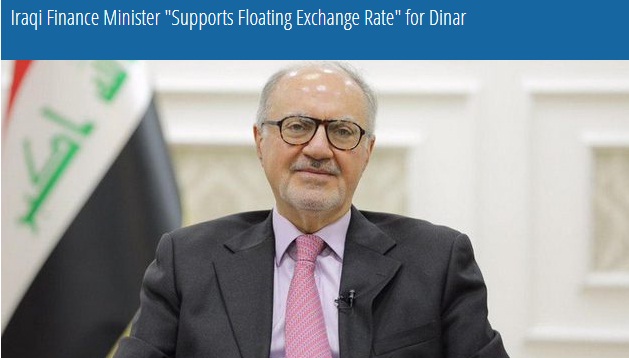
 Shafaq News/ Finance Minister Ali Abdul Amir Allawi confirmed on Thursday that he supports floating the currency in a flexible manner.
 Finance Minister Ali Allawi announced that the process of changing the exchange rate was not easy, and while he indicated that Iraq came out of the difficult economic situation safely, he revealed the reasons for the delay in paying salaries.
 Shafaq News/ The Iraqi government announced on Thursday that there is no need to borrow from the International Monetary Fund, describing at the same time the relationship between the two sides as “very good.”