Al- Ugaili reveals massive corruption and the reason for preventing the opening of large files

Al- Ugaili reveals massive corruption and the reason for preventing the opening of large files

Figures .. Al-Ugaili reveals the enormous corruption and the reason for preventing the opening of large files

Former head of Integrity, Rahim al-Ugaili, revealed the size of the huge corruption files and the reason for preventing large files from being opened.

“There is a positive development in dealing with the issue of corruption,” he said. “The circumstances of the protests and the popular uprising in Iraq may have led the investigative and judicial bodies to carry out their duties more seriously, which is a more promising gesture at the hands of the judiciary and the Integrity Commission in those procedures.”

He pointed out that “people may be worried about two things. First, we hope that these measures will not be a reaction to the popular protests. After that, the second thing is that the new measures that we have seen good are no doubt about their safety.” Corruption issues known to the Iraqi people.

Al-Okaili added: He pointed out that “there is concern that these prosecutions will be limited to some small issues; but as long as the judiciary and the life of integrity find popular support we will find open to these issues, but I think that the political blocs and parties intervening in the judicial and investigative are prevented the opening of large files,” but “will not There will be no anti-corruption unless you open the big files and prosecute the corruption. ”

“One of the senior politicians once said that opening the big corruption files will topple the political system and political heads that are symbols at the present time,” he said. Dangerous files involving senior political leaders. ”

As for the Anti-Corruption Council, the former head of the Integrity Commission explained, “This council is not an investigative institution or a judicial institution, but it is a coordinating institution that has no role in investigating or dealing with the files of corruption by bringing the accused or arresting them. “As a subordinate to the highest executive in Iraq, he can bring the information, evidence and documents to the investigative and judicial bodies.”

He added, “Regulators are subject to the control of other parties, so I do not think there is concern about this issue and I think that the issue of corruption or misbehavior within the integrity of the integrity is not serious within the limits that we call.”

On the indicators of corruption and the amount of money lost Okaili confirmed, “according to estimates and media reports pointed to nearly {350-400} billion wasted between the years 2006-2014, and there are indicators pointing to more than (6) thousand projects worth {227} billion Iraqi dinars The percentage of completion in spite of the expiration of the implementation period between {1-5%} only and {12} thousand projects until 2012, of which only {500} projects have been implemented despite the disbursement of all the funds of those projects.

“Obviously in the land features, you don’t find in Iraq spent or income to the budget actually about {1100} billion dollars,” he asked. “Where did the money go, we did not find any impact only in the Kurdistan region somewhat, but the rest of Iraq does not find It has an impact, although I once heard from former Central Bank Governor Sinan al-Shabibi saying that it is possible to spread the land of Iraq gold, but I say no doubt that it went into the pockets of corrupt. ”

Alforatnews.com

Posted in Uncategorized | Comments Off on Al- Ugaili reveals massive corruption and the reason for preventing the opening of large files

A deputy intends to investigate the auction of the currency and confirms the possession of the names of those involved

A deputy intends to investigate the auction of the currency and confirms the possession of the names of those involved

Information / special .. A member of the Parliamentary Integrity Committee high Nassif, on Thursday, the committee’s move to open an investigation auction currency, indicating that there are a lot of personalities involved in this area will be referred to the judicial authorities.

Nassif said in a statement to the information, that “the Parliamentary Integrity Committee, especially after the completion of a law from where you get this, it is heading towards opening the currency auction in the Central Bank.”

She added that “the Chairman of the Committee will form a team of members of the House of Representatives in order to open an investigation auction currency, in addition to the Office of Financial Supervision expressed cooperation with the Commission on Integrity and confirmed that there are files ready on the auction of currency.”

She pointed out that “next Saturday will be the formation of the said team to investigate the auction of the currency, and referring the perpetrators to the judiciary, where there are indications of some people who did not have property before 2003, while they find owners of banks and large property, and therefore the law from where you will apply this on them”.

She stressed that “the Commission on Parliamentary Integrity owns the names of banks and personalities involved in corruption of currency auction, where there are many of them used the period after 2014 to increase its funds.” Finished 25 N

Almaalomah.com

Posted in Uncategorized | Comments Off on A deputy intends to investigate the auction of the currency and confirms the possession of the names of those involved

Al-Sayadi: The law “Where did you get this?” will eliminate money laundering and corruption

Al-Sayadi: The law “Where did you get this?” will eliminate money laundering and corruption

Between the independent MP Kazem al-Sayadi, Wednesday, that the law “from where you this” will eliminate money laundering and corruption, pointing out that the popular pressure is the law that restored “graft” to the interface.

“The political forces have lost their confidence with themselves and the street,” Sayadi said in a televised statement.

He added that “the money dissolved their contracts allocated to them from recycling funds, they have a service for more than five years and deserve to return, as their return will make the people satisfied with the state.”

He added: “The constitution was born dead and will not be able to breathe life to Iraq,” pointing out that “popular pressure is the restoration of the law of graft for the interface, in addition, the law from where you this will eliminate money laundering and corruption.” Finished 25 N

Almaalomah.com

Posted in Uncategorized | Comments Off on Al-Sayadi: The law “Where did you get this?” will eliminate money laundering and corruption

Iraqi figures on the US sanctions list on charges of corruption and repression

Iraqi figures on the US sanctions list on charges of corruption and repression

BAGHDAD – The United States plans to take punitive measures against Iraqi figures over their involvement in the use of lethal force to quell mass popular protests that began in early October and continue for the 50th consecutive day, informed sources in Baghdad said.

The sources told “Arabs” that Washington is also considering punishing Iraqi figures from the first political line, on charges of corruption and violation of human rights.

According to the sources, there are two lists that may be issued by the US Treasury soon, including the names of five Iraqi figures, which will be covered by financial sanctions in accordance with the laws in force in the United States.

The sources pointed out that the new US sanctions, will be extended to three prominent Iraqi figures, closely linked to the Iranian Revolutionary Guard and the Popular Mobilization militias, pointing out that “Abu Jihad al-Hashemi, Director of the Office of Iraqi Prime Minister Adel Abdul Mahdi, put his name at the top of the list of punished figures.”

Fog has surrounded the fate of al-Hashemi since the beginning of this month, after the leaked office of Abdul-Mahdi news of his resignation, and the appointment of Qais al-Amiri, close to Faleh al-Fayyad, head of the Popular Mobilization Authority, in his position.

Hashemi is described as the de facto prime minister in Iraq since the formation of Abdul Mahdi’s government, which confirms the sources accompanying that he chose the most prominent pillars, while other sources say that “Abu Jihad is the financial coordinator of the activities of the Iranian Revolutionary Guard in Iraq, which includes billions of dollars in the areas of housing, entertainment, tourism and materials Food. ”

The sources confirm that the decision to resign al-Hashemi was a formality, to suggest to the public that it is far from the office of Abdul-Mahdi when the list of sanctions to come out in public.

The second figure, who sources say will be on the sanctions list, is Hossein Faleh, known as Abu Zainab al-Lami, the head of the PMU’s private security service, known as the personal companion inside Iraq of senior Revolutionary Guards general Qasem Soleimani.

The third person under US sanctions is Ahmed al-Asadi, a member of the Fatah bloc and leader of the Jund al-Imam Brigades.

Personalities targeted:

Abu Jihad al – Hashemi , Director of the Head of Government Office

Hussein Faleh Security Service chief in the popular crowd ,

Ahmed al – Asadi Soldiers Brigades leader Imam

Nuri al – Maliki , the leader of a coalition of state law ,

Hadi al – Ameri , leader of the Alliance of Conquest

Sources confirm that these figures are directly involved in the coordination of sniper and killed and injured and the arrest and abduction Thousands of demonstrators, activists and journalists across the country have been experiencing protests since the beginning of last month.

The sources point to the existence of US financial sanctions against another list, including the names of high caliber in Iraq, such as the leader of the coalition of law Nuri al-Maliki and the leader of the conquest coalition Hadi al-Amiri.

The sanctions against al-Maliki and al-Amiri related to corruption and human rights violations, while the sources confirm that the United States is considering putting the name of the head of the Popular Mobilization Commission, Faleh al-Fayyad, on the same list, which includes the leaders of the rule of law and Fatah on similar charges.

Such sanctions would impose complex financial constraints on the movement of funds for persons listed in the Regulations.

US Secretary of State Mike Pompeo said on Monday the administration would not stand idly by “while we see corrupt officials making the Iraqi people suffer.”

He stressed that the United States will impose sanctions on corrupt figures who steal the wealth of the Iraqi people.

He added that the protests in Iraq do not distinguish between communities and ethnic groups, but wants to get rid of Iranian interference, pointing out that the United States remains the largest donor of humanitarian aid in Iraq.

But an Iraqi observer played down the seriousness of the leaks and predicted that government sources with limited influence had leaked them, with the aim of spreading terror among Iranian figures, whose presence was heavy on the political system.

The observer told Al-Arab, “It can be said that the protests have strengthened one wing of the last wing of the regime in Iraq, so that the wing dare to declare its desire to exclude the faces that have become subordinate to Iran is a burden on Iran itself. All this means that there is an intent to conduct liquidations within the regime, supervised by Iran in order to delude the protesters that there is a real response to their demands.

“Even if the leaks are real, they may be part of a plan to soak up popular anger and divert it from demanding the fall of the entire sectarian system and turn the page of corruption into attention to the fragments of the already existing conflict between the pre-existing wings of the regime under Iranian auspices.”

He ruled that this would affect the protesters and reduce the ceiling of their demands because it is a prosthetic solution, like the ministerial changes, which they refused to consider a solution, stressing that the violence against the demonstrators was not an individual behavior as it was a systematic policy linked to an Iranian defense plan, details of which were illustrated by the recent repression Inside Iranian cities.

The Arabs

Rawabetcenter.com

Posted in Uncategorized | Comments Off on Iraqi figures on the US sanctions list on charges of corruption and repression

Kurdish source reveals details of “final agreement” between Erbil and Baghdad on the 2020 budget

Kurdish source reveals details of “final agreement” between Erbil and Baghdad on the 2020 budget

Baghdad Today – Baghdad: An informed Kurdish source revealed on Friday, November 22, 2019, the details of the “ final agreement ” between the Kurdistan region and the central government on the 2020 budget.

The source told (Baghdad today), “a delegation from the Kurdistan Regional Government, headed by the Minister of the region, Khalid Shwani will visit Baghdad mid next week, to discuss the agreement with Baghdad on the region’s share of the budget and financial situation between Baghdad and Erbil.”

He added that “there is a preliminary agreement to deliver 250 thousand barrels of oil to Baghdad in return for the federal government pledged to pay the salaries of employees full salaries of the Peshmerga in addition to the delivery of Arbil 13% of the budget and the province will deliver daily oil and revenue crossings to the government.”

He pointed out that “Baghdad is waiting for the signing of the final agreement with the region for the government to send the budget to parliament.”

Hassan Ali, a PUK MP, said Tuesday (19 November 2019) that negotiations between Baghdad and Erbil would resume next week.

Ali said in an interview with (Baghdad today) that “the lack of agreement between Baghdad and Erbil to approve the draft budget in 2020 because the Council of Ministers is waiting for agreement between the parties on the proportion of the region.”

He added, “The dialogues that were postponed due to the demonstrations will be resumed next week for the purpose of allowing the government to send the draft budget to parliament to vote on it as soon as possible so that the government can implement the demands of the demonstrators.”

He pointed out that “will be a discussion on the share of the region and the continued distribution of salaries and dialogue on the delivery of Erbil to the oil receivables in return for Baghdad’s commitment to implement the financial commitments made.”

Negotiations on budget issues, oil deliveries and the participation of people in the disputed areas in the upcoming elections were interrupted after demonstrations broke out in Baghdad and a number of central and southern provinces in early October, which forced negotiations and dialogues between Baghdad and Erbil to stop several times.

Baghdadtoday.news

Posted in Uncategorized | Comments Off on Kurdish source reveals details of “final agreement” between Erbil and Baghdad on the 2020 budget

Iraq dinar is short-term disappointment, long-term bet (Flashback)

Iraq dinar is short-term disappointment, long-term bet

October 3, 2012

MIDEAST MONEY

By Aseel Kami

BAGHDAD, Oct 3 (Reuters) – Many Iraqis have lost faith in their dinar currency but to some foreign speculators, it promises big profits. The contrast underlines the uncertainties of investing in Iraq as the country recovers from years of war and economic sanctions.

The logic of the dinar bulls is simple. Iraq’s oil exports rose to 2.6 million barrels per day in September, their highest level in three decades; the country aims to hit 6 million bpd by 2017, which would put it close to Saudi Arabia’s current level.

Even if unstable politics, militant violence and bureaucratic inefficiency prevent that target from being hit, Iraq still seems to be on the threshold of an oil boom that will transform its finances.

Inflows of new oil revenue could give the country big external surpluses and push state finances deep into the black by late this decade – the classic recipe for a strong currency.

“As far as our investors are concerned, when they buy Iraqi dinars they do know it is a long-term investment. You know it takes time for a country to rebuild itself,” said Hassnain Ali Agha, president of Dinar Trade, a U.S. dealer of exotic currencies.

Because the dinar is not freely traded by banks outside Iraq, online dealers of banknotes such as Dinar Trade are the only way that most foreigners can invest in the currency. The Las Vegas-based company says it sells as much as hundreds of thousands of dollars worth of dinars daily, shipping dinar notes to thousands of customers in the United States and elsewhere.

Agha said that because of optimism about Iraq’s oil wealth, there had been solid demand for dinars since his company was founded in 2004, a year after the U.S. invasion which triggered years of political violence and economic turmoil.

Back in Baghdad, however, Iraqis themselves are not convinced. Many take what opportunities they have to change their dinars into hard currency, and conduct all but small day-to-day transactions in U.S. dollars.

“We have no trust in the Iraqi dinar – we feel afraid to save it. We trust the dollar more. The dollar does not go up and down, it is fixed,” said housewife and mother-of-two Eman Saadeldine.

WILD SWINGS

The dinar has endured wild swings over the past three decades. In the 1980s, one dinar bought around $3, but economic sanctions imposed on Iraq around the time of the 1991 Gulf War sent the currency into decline and stoked inflation, which the government fuelled by printing money. By late 1995, $1 bought as much as 3,000 dinars.

After the 2003 invasion, the central bank intervened in the currency market to strengthen the dinar, using its supplies of dollars to manage the exchange rate.

But over the last several years, even as Iraq’s oil production has expanded, there has been none of the appreciation for which speculators have been hoping. The central bank now sells dollars in daily auctions at a fixed price of 1,166 dinars, a level barely changed since 2009.

In fact, the dinar has recently faced downward pressure as a result of the international economic sanctions imposed on neighbouring Iran and Syria. Iraqi traders rushed to buy dollars to sell on illicitly to residents and businesses in those countries, which are hungry for hard currency.

The dinar fell as low as 1,280 in the open market this year before Iraqi authorities reacted by allowing two state-run banks and some private lenders to sell dollars, helping push the exchange rate back to around 1,200 currently.

Another factor counting against the dinar is the fact that the largest banknote is only 25,000 dinars. This often makes the currency unattractive to use in an economy where the banking system is primitive and deals are often done in cash.

Saadeldine recalls paying in cash for a new house in 2009.

“If our money had been in dinars, it would have been impossible for us to carry it. It was in dollars and we carried it in a small suitcase,” she said.

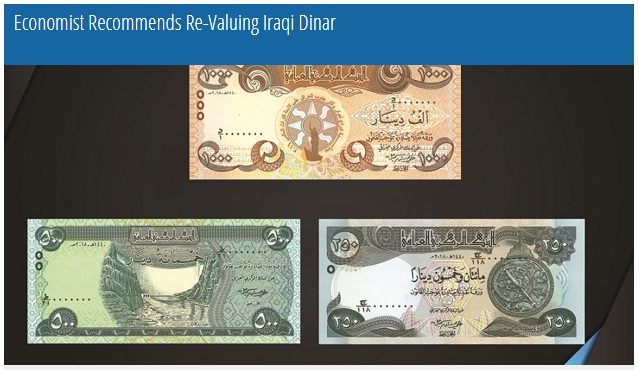
The central bank has been considering plans to knock three zeros off the nominal value of banknotes to simplify financial transactions. This would not in itself increase the real value of the dinar, since prices would adjust in line with the redenomination, but economic experts say it could improve confidence in the dinar and thus boost its value eventually.

“It would increase trust in the dinar even though its value would not change,” said Baghdad-based economist Majid al-Souri. “Indirectly, when trust increases there will be appreciation.”

Earlier this year, however, the cabinet decided to suspend the technically complex redenomination plan until further notice, saying the economic climate was not suitable.
The biggest obstacle to dinar appreciation is the fact that for now at least, Iraqi authorities appear content with the exchange rate in its current range.

In a memorandum to the International Monetary Fund on economic and financial policies for 2011, written in March that year, the Iraqi government said it saw benefits in keeping the dinar stable.

“We believe that the policy of maintaining a stable exchange rate continues to be appropriate, as it provides a solid anchor for the public’s expectations in an otherwise uncertain environment and in an economy with a still very low level of financial intermediation,” it said.

LONG TERM

In the long term, however, Iraq’s finances and economy may improve so dramatically that authorities feel comfortable allowing the dinar to appreciate under the pressure of flows of oil money into the country.

The IMF expects this year’s estimated budget surplus of just 0.2 percent of gross domestic product to balloon to 12.1 percent in 2017. The country’s balance of trade in goods and services, in deficit as recently as 2010, is projected over the next five years to shift to a large surplus of 11.3 percent of GDP.

Deputy central bank governor Mudher Kasim told Reuters that he expected redenomination of the dinar to go ahead in 2014 or later, by which time the amount of Iraqi currency in circulation would have increased significantly, making financial dealings in cash even harder.

In the long term, the central bank aims to make 1 dinar equal to $1 with a combination of redenomination and appreciation, although that will take over three years because of instability in the Middle East, Kasim said: “If not for the regional circumstances, we would proceed faster with that plan.”

Some analysts think the appreciation could go further. Kamal al-Basri, research director at the Iraqi Institute for Economic Reforms, an independent research body in Baghdad, said he expected the dinar to stay stable for the next three years, but that afterwards it might strengthen beyond parity against the dollar, including the effect of redenomination.

For that to happen, Iraqi politics will have to stabilise, skill and education levels rise and the economy diversify so that it is not so heavily dependent on oil exports, he said.

Speaking at the Baghdad currency exchange shop that he owns, Ahmed Abdul-Ridha said the dinar’s stability in the past three years was good, but it did not indicate the long-term trend.

“We wish the dinar’s value would go back to what it was like before, when it used to equal $3 in the 1970s and even in the 1980s,” he said.

“I expect that day will come. Why not? What we are going through is an abnormal condition…We are an oil country.”

Our Standards:The Thomson Reuters Trust Principles.

Reuters.com

Posted in Uncategorized | Comments Off on Iraq dinar is short-term disappointment, long-term bet (Flashback)

The Central Bank withdraws two companies’ leave in the midst of buying and selling currencies

The Central Bank withdraws two companies’ leave in the midst of buying and selling currencies

The Central Bank of Iraq, on Thursday, on the withdrawal of two companies brokerage license to sell and buy foreign currency for violating instructions.

The bank said in a statement that “in view of the violation of the splendor of the spring and the ocean to broker the sale and purchase of foreign currencies to the provisions of the regulations governing the work of mediation companies and the fight against money laundering and financing of terrorism, it was decided to withdraw the license to establish the two companies.”

“It was also decided to confiscate the letter of guarantee of the Ocean Company issued by the South Islamic Bank for Investment and Finance, which amounted to 50 million dinars in favor of the bank, as well as the confiscation of insurance deposits deposited with this bank, which amounted to 50 million dinars in his favor,” it said.

The bank demanded “the Ministry of Commerce to cancel the founding certificate granted to them by him, in addition to delisting their name from their records and provide the Central Bank with a letter of liquidation certified.”

Burathanews.com

Posted in Uncategorized | Comments Off on The Central Bank withdraws two companies’ leave in the midst of buying and selling currencies

US State Department denies Pompeo’s intention to resign

US State Department denies Pompeo’s intention to resign

Baghdad Today – US State Department spokesman Morgan Ortacus has denied reports in the US media that Secretary of State Mike Pompeo is planning to resign.

The US media, published news that the US Secretary of State, Mike Pompeo told three officials that he intends to resign from his position, and that he intends to run for the Senate from Kansas.

The Time magazine, which originally published the news, cited three Republican officials, without mentioning their names, one in the administration of President Donald Trump, the other in the government, and the third, a former employee who rotated several positions in US government.

Pompeo had intended to stay until the spring of 2020 as US secretary of state, but the US media said he may “come after looking for a way out of the crisis.”

In the event of the resignation of the Secretary of State, he will be the 70th official to resign from the Trump administration, where the figure includes officials who have been dismissed by the US president himself.

Baghdadtoday.news

Posted in Uncategorized | Comments Off on US State Department denies Pompeo’s intention to resign

Barzani calls for giving the government of Abdul-Mahdi a chance to achieve reforms: (They) do not bear the full guilt

Barzani calls for giving the government of Abdul-Mahdi a chance to achieve reforms: (They) do not bear the full guilt

Baghdad Today – Baghdad: The head of the Kurdistan Regional Government, Masrour Barzani, on Wednesday (November 20, 2019), to give the government of Prime Minister Adel Abdul Mahdi, an opportunity to achieve the necessary reforms for the Iraqi people, noting that they do not bear all the guilt alone, because what happens as a result of the accumulations of previous years.

“The Iraqi crisis is not the result of the constitution itself but its failure to implement it. Iraqi politicians are addressing the symptoms of the problem, not its causes,” Barzani said during a meeting on the sidelines of the Middle East Peace and Security Forum at the American University in Dohuk.

He added that “the demands of the demonstrators are legitimate and right and we support them, and the Iraqi government to take their demands seriously and respond to them and secure a better life for them.”

He pointed out that “what is happening in Iraq we expected for years and the current government alone does not bear the guilt for everything that is going on, but should be given a chance to achieve the necessary reforms for the Iraqis,” It imposes itself on the Iraqi political scene. ”

“By virtue of its geopolitical position, if Iraq does not have its own strategy, it will always be subject to international and regional interference,” he said.

And Barzani, that “the problem is not in the Constitution itself, but in the lack of attention and application of its articles selectively, in addition to that all the system and the way the Iraqi administration is not committed to the Constitution and does not respect the demands of the various components and segments.”

“ISIS has not ended. It has lost areas of yes, but it remains as an ideology. There are thousands of supporters in Syria, Iraq and the region.

The head of the Kurdistan Regional Government, he “aspires to create a strong economy for the region, to provide more jobs for citizens, in addition to solving problems with Baghdad and enjoy normal relations with all parties and countries.”

Barzani stressed the “desire of the Kurdistan Regional Government to be a factor of stability and security in the region, through the fight against terrorism with the international community, there is no acceptance of extremism in our society.”

Baghdadtoday.news

Posted in Uncategorized | Comments Off on Barzani calls for giving the government of Abdul-Mahdi a chance to achieve reforms: (They) do not bear the full guilt

Pompeo: US will sanction Iraqi officials for corruption, attacking protestors

Pompeo: US will sanction Iraqi officials for corruption, attacking protestors

Pompeo: US will sanction Iraqi officials for corruption, attacking protestors

WASHINGTON DC (Kurdistan 24) – US Secretary of State Mike Pompeo announced on Monday that the United States would start to impose sanctions on corrupt Iraqi officials, as well as those involved in violently suppressing the protests in Iraq.

No individuals were named on Monday, but as Pompeo stated, “We will not stand idle,” while “corrupt officials make the Iraqi people suffer.”

“Today, I am affirming the United States will use our legal authorities to sanction corrupt individuals,” he continued, specifying those “stealing Iraqis’ wealth and those killing and wounding peaceful protesters.”

“Like the Iraqi people taking to the streets today, our sanctions will not discriminate between religious sect or ethnicity,” Pompeo affirmed. “They will simply target those who do wrong to the Iraqi people, no matter who they are.”

Iraq has been wracked by protests for over a month and a half. Both the United Nations Assistance Mission in Iraq (UNAMI) and Iraq’s top Shia cleric, Ayatollah Ali Sistani, have called for government reforms and an end to its use of violence against the protesters.
“For the last few weeks, the United States has watched the protests very, very closely,” Pompeo said. “We support the Iraqi people, “as they strive for a prosperous Iraq that is free of corruption and Iranian malign influence.”

“Iraq’s leaders must protect human rights, as Iraqis lift their voices to secure a flourishing democracy,” he affirmed.

The demonstrations are largely a Shia protest against a Shia-dominated government. Although directed against the Iraqi government, they are also protests against Iran’s strong influence in Iraq, with those political parties and militias with close ties to Tehran particularly targeted.

Indeed, the Iranian consulate in Karbala – the holy city with the shrine of Imam Hussein and his half-brother, Abbas – was attacked by an angry crowd earlier this month.

The demonstrators are demanding an end to corruption, and they seek radically improved public services. Indeed, Iraq is one of the most corrupt countries in the world, ranking 168 (out of 180 countries) on Transparency International’s corruption index.

Those who have come of age since the overthrow of Saddam Hussein might be astonished to learn that the George W. Bush administration believed that establishing responsible, competent, and democratic government in Iraq would be easy.

Washington was, then, still steeped in the triumphalism of the collapse of communism, what Frank Fukuyama once called “the end of history.” Bush was persuaded that he could do to the Middle East, what Ronald Reagan had done to the former Soviet bloc: transform the region.

It is now clear that the demise of communism did not end what is a long-standing struggle between the liberal democracies of the west and the east’s more authoritarian regimes. And societies are not “transformed,” merely by replacing one set of rulers with another.

Sixteen years later, the US continues to grapple with how best to deal with this situation. Until these protests, Washington had generally deferred to Baghdad, regularly affirming that it supported the sovereign decisions of the Iraqi government.

However, Pompeo’s announcement suggests that may be changing, as the US looks to start a more focused effort to promote better governance in Baghdad, in support of the Iraqis’ popular demands.

Such a course, however, is not easy, and it has pitfalls. Above all, while many of the protestors’ grievances are legitimate, the protestors seem to have little idea of how to achieve what they want.

Some of the protestors have called for changing the Iraqi Constitution, but as Bayan Sami Abdul Rahman, the Kurdistan Regional Government’s representative in Washington, asked: “In what ways?” Suggesting it would be better first to try actually implementing the constitution.

Protestors have also called for a presidential system. That would, of course, be a Shia president—who could even become a Shia version of Saddam Hussein.

“Iraq has had a history of strong men, and strong men are not going to resolve the difficulties in Iraq,” an informed source advised Kurdistan 24.

“It is a classic feature of semi-democratic polities that people cry out for a strong man and have dictator nostalgia,” he continued. “It’s unfortunate, but it’s a genuine syndrome. And that’s what we’re seeing.”

Indeed, the protestors might be careful of what they wish for. It is not impossible that Iran is actually encouraging the demand for a presidential system. And its calculation could be that a strong Shia figure ruling Iraq would make it easier for Tehran to dominate the country—the exact opposite of what the protestors want!

Kurdistan24.net

Posted in Uncategorized | Comments Off on Pompeo: US will sanction Iraqi officials for corruption, attacking protestors