
Soleimani’s legacy opens a new front in Iraq… A long war awaits Trump
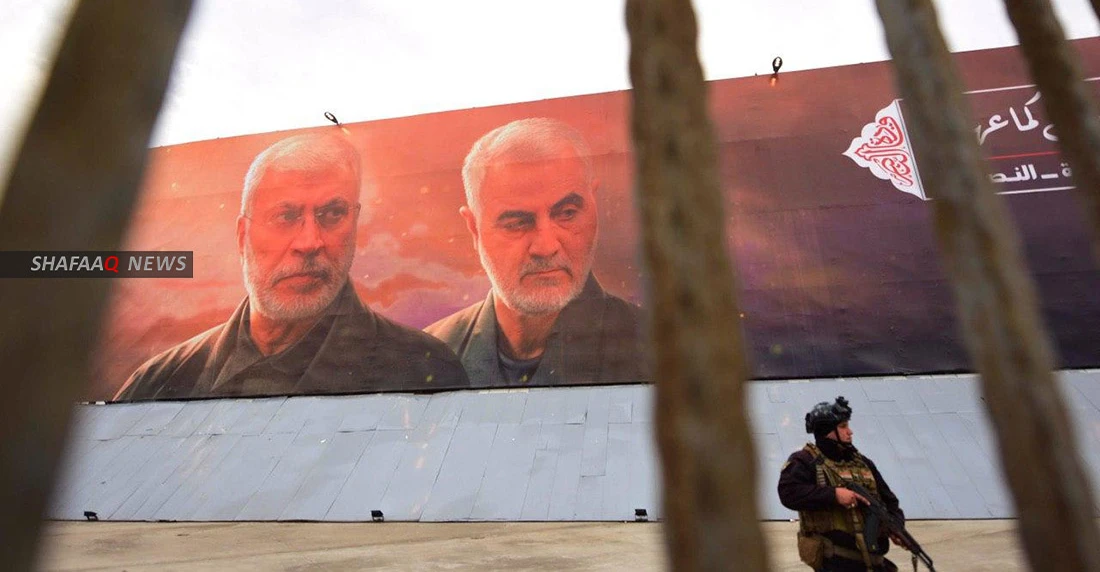 More than six years after the assassination of former Iranian Quds Force commander Qassem Soleimani, his legacy is haunting US President Donald Trump, but this time through the network of armed factions that he helped build inside Iraq, which appear capable of transferring the war from Iran to Iraqi territory, and opening new fronts that make the confrontation longer, more complex and costly. News
According to a report by the British newspaper “The Telegraph,” translated by Shafaq News Agency, the Iraqi factions represent one of the most important cards of power that Tehran possesses to plunge the United States and its allies into a multi-front conflict, and to turn Iraq into an alternative arena of confrontation, while Iran remains relatively far from direct strikes.
According to the report, Soleimani’s strategy, based on building armed groups outside Iran’s borders, appears to be achieving one of its goals, after the American and Saudi strikes moved into Iraq, instead of the confrontation remaining confined to Iranian territory.
He pointed out that more than six years after the assassination of Soleimani and the deputy head of the Popular Mobilization Forces, Abu Mahdi al-Muhandis, in an American strike in Baghdad, carried out on Trump’s orders, Iraqi factions have returned to the heart of the regional conflict.
The report noted that the United States and Saudi Arabia held factions within the Popular Mobilization Forces responsible for attacks targeting their interests, before carrying out joint strikes on Popular Mobilization Forces sites inside Iraq, resulting in dozens of deaths and injuries.
The British report argued that these developments revived the model of conflict that Soleimani had worked to establish: armed groups capable of targeting Iran’s adversaries from outside its borders, and pushing them to retaliate in other arenas.
According to the report, moving the strikes to Iraq could give Tehran a strategic advantage by expanding the scope of the war and involving new parties and fronts, thus raising the cost of the confrontation and making it more difficult for Washington to control its course.
The report explained that the armed groups that emerged after the American invasion of Iraq in 2003 gradually transformed into a powerful military, political and economic force, noting that some factions possess arsenals that include long-range missiles and anti-aircraft weapons, in addition to networks of influence within political and economic institutions.
He pointed out that its influence is no longer limited to the military aspect, as it has political parties, seats in the House of Representatives, and positions within state institutions, in addition to commercial interests and extensive economic networks. This overlap between weapons, politics, and the economy has made the factions more entrenched, and has transformed them from armed groups into forces that are difficult to deal with as separate entities from the state.
The newspaper quoted an Iranian analyst as saying that the Iraqi factions represent “important assets,” but added that complete control over them remains a complex task.
The analyst said these groups were useful to Iran in keeping the threat of ISIS away from its borders, and that they are currently being used to put pressure on the United States and expand the scope of the war, but he warned that Tehran may ask more of the factions than they can deliver, saying that the Iranian regime “expects more from them than they can do.”
He pointed out that these groups are not easy targets, due to their reliance on social and local networks, which gives them the ability to reorganize and continue even if they are subjected to military strikes.
The report quoted another analyst based in Tehran as saying that the factions may not have the ability to change the military balance of power, but they are capable of expanding the war and moving it into Iraq, adding that “their main mission is to move the war from Iran to Iraq, and that opening an Iraqi front will lead to the involvement of new parties and increase the complexity of the conflict.”
He argued that the United States could inflict significant damage on the factions in a short period, but that any large-scale military campaign could make Iraq an official part of the war, which might align with Tehran’s interests. He said that the expansion of the number of fronts and players would make the war more costly and difficult, and could put the Trump administration in front of a long confrontation whose results could not be controlled.
According to an Iranian official who spoke to the newspaper, Tehran will defend the Iraqi factions in the same way it supported the Lebanese Hezbollah.
The report quoted the official as saying that these groups represent “the backbone of the resistance forces in the region,” and that their multiplicity and proximity to Iran constitute a source of strength for them.
He added that some members of the factions were present in Iran during the war, to help support the security forces, control the streets, and prevent anti-government protests.
He noted that some of these individuals have begun returning to Iraq following recent developments, while the official stated that aid “has already begun its way to Iraq” to support the factions and enable them to defend themselves.
After reviewing the history of the emergence and development of the factions and the formation of the Popular Mobilization Forces, the report indicated that groups close to Iran, such as Kataib Hezbollah, Asaib Ahl al-Haq and Harakat al-Nujaba, represent one of the most important pillars of Iranian influence inside Iraq.
He pointed out that the United States has designated a number of these groups as “terrorist” organizations, while some factions have refused full integration into the Iraqi armed forces, and have clung to their affiliation with what is known as the “axis of resistance” and their connection to the principle of “Guardianship of the Islamic Jurist.”
According to the British report, the integration of the factions into the Iraqi political and security structure makes weakening or dismantling them a very complex task, despite the continued American pressure on Baghdad to limit their influence and control their weapons.
He stated that military experts believe that the Iraqi Prime Minister cannot dissolve the Popular Mobilization Forces with a unilateral decision, and that ending its existence cannot be achieved with a religious edict, given the political weight that the factions and parties allied with it possess within the House of Representatives, noting that the forces associated with the Popular Mobilization Forces do not seem ready to vote against its continued existence or to give up its political and military influence.
According to the report, the United States and its allies do not want the pressure on the factions to lead to the collapse of the Iraqi state or to turn the country into a chaotic arena similar to Syria.
But this caution, according to the newspaper, gives the factions more room to maneuver, and makes dealing with them more complicated, especially given their connection to state institutions and their extensive political and economic influence.
The Telegraph report concluded that the Popular Mobilization Forces are now in the position that Iran wants them to be: an inseparable part of the Iraqi state, difficult to get rid of in a “clean” way, and at the same time capable of opening a new front and turning Iraq into a battlefield at any moment.
Shafaq.com