
The Zaidi government: Qaani clings to the “weapon of resistance” and clashes with Trump’s conditions.
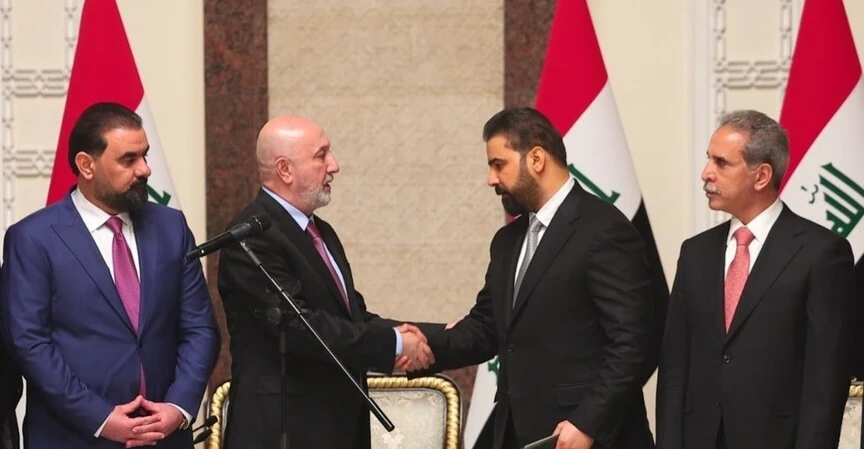 The Americans and Iranians explored the issue of nominating Ali al-Zaidi to form the Iraqi government before his appointment was announced, while the commander of the Iranian Quds Force, Ismail Qaani, urged the Iraqi officials he met to avoid excluding faction leaders from the government or seeking to disarm them.
According to information from the American newspaper ” The Wall Street Journal ,” which addressed the issue of assigning al-Zaidi, he became the choice of US President Donald Trump, but on the condition of excluding the factions, in a position that reflects the conflict between Tehran and Washington.
The American newspaper, in a report translated by Shafaq News Agency, indicated that al-Zaidi enjoys the support of Trump, who invited him to Washington, stressing that the United States “strongly supports him,” adding that this support from the White House came conditional on al-Zaidi excluding Iranian-backed militias from the next Iraqi government and limiting Tehran’s influence in Baghdad.
The newspaper, quoting current and former US officials, noted that al-Zaidi had previously faced similar US pressure, as he owns a bank that the Treasury Department banned from dealing in dollars in 2024, on suspicion of dealing with a militia leader linked to the Iranian Revolutionary Guard.
According to the report, al-Zaidi is a compromise choice, after Trump threatened to cut off US aid to Iraq when former Prime Minister Nouri al-Maliki was nominated, following months of political negotiations.
The newspaper also quoted Iraqi officials as saying that the United States and Iran “inquired about the nomination before it was announced,” noting that al-Zaidi received phone calls from Trump and Iranian President Masoud Pezeshkian.
Iraqi officials said that Esmail Qaani, during a visit to Baghdad on Sunday, urged Iraqi officials not to exclude militia leaders from the government or attempt to disarm these groups.
The report indicated that a senior official in the US State Department explained that Washington is seeking to take concrete measures against the militias, for carrying out 600 attacks on US diplomatic and military sites in Iraq since the start of the “American-Israeli” war on Iran.
Analysts were quoted as saying that the White House’s demand for al-Zaidi to confront the militias represents a serious political risk, indicating that any attempt to disarm the militias or limit their influence could provoke a violent reaction.
Victoria Taylor, a researcher at the Atlantic Council who oversaw Iraq policy as an official in the US State Department during the Joe Biden administration, explained that “armed groups have deeply entrenched themselves in the Iraqi state and its economic system, and regardless of who the prime minister is, reducing the influence of these groups will be a difficult and long-term process.”
The report continued, saying that current and former US officials say the Treasury Department’s decision to ban the South Islamic Bank from dealing in dollars is based on intelligence indicating a link between the bank and the Secretary-General of the Imam Ali Brigades, Shibl al-Zaydi, who was sanctioned by the US in 2018 for alleged involvement with the Iranian Revolutionary Guard and his connection to Hezbollah.
According to the officials themselves, among the other factors on which the Treasury Department’s decision was based was information indicating the possibility of close ties between the bank and Kataib Hezbollah, which the United States has designated a “terrorist” organization, as stated in the report.
In this context, the Chairman of the Board of Directors of Bank of the South, Mazen Ahmed, said that the bank is “aware of these allegations” issued by the Treasury Department, “but confirms that they are false allegations based on rumors and speculations,” adding that the bank, at the request of the Treasury Department, conducted several independent reviews of its operations which concluded that these allegations were untrue, but he declined to provide copies of these reviews.
The newspaper indicated that Ali Al-Zaidi owns 9.90% of the bank’s shares and, along with other members of his family, controls the majority of its shares.
Ahmed pointed out that Al-Zaidy “does not play any direct role or responsibility in the bank’s operations, and has not played any role in this area since 2019, when he stepped down from his position as Chairman of the Board.”
The report also stated that the prime minister-designate and the Bank of the South are now subject to official US sanctions.
A spokesman for Shibl al-Zaidi was quoted as saying that there is “no political or commercial relationship” between him and the prime minister-designate, nor are there any familial ties between them through marriage.
According to the spokesman, who is named Hussam al-Rubaie, the two men belong to the Zaidi clan, which numbers about 300,000 people.
The report stated that the Treasury Department announced in 2018, when it imposed sanctions on Shibl al-Zaidi, that he “acted as a financial coordinator” between the Quds Force and militias in Iraq, and helped facilitate what it called “Iraqi investments” for Qassem Soleimani at the time. However, al-Rubaie stressed that “there is no evidence to support these claims, and the relationship with Qassem Soleimani was limited to the military field.”
Al-Rubaie added that Shibl al-Zaidi, in addition to his role in the factions, also leads the Services Alliance, which won nine seats in the House of Representatives during the November elections, and belongs to the coordinating framework that nominated Ali al-Zaidi, with the support of the Services Alliance for him.
In response to questions about Shibl al-Zaidi and the South Bank, a Treasury spokeswoman said, “The Treasury Department has worked closely with its counterparts in Iraq to identify illicit financial threats, including money laundering and terrorist financing by pro-Iranian militias, and to take the necessary actions to counter them.”
The newspaper stated that the decision to ban the South Bank was a blow to Baghdad, because the bank was managing international purchases of basic commodities on behalf of Al-Zaydi’s other company, “Al-Awais,” for the benefit of the Iraqi food basket program, a monthly government program to distribute flour, rice, sugar, cooking oil and other basic foodstuffs to those in need.
The report concluded by saying that the US embargo posed a particular threat to Iraq’s large rice imports from US producers, but that Treasury and Iraqi officials devised an alternative solution that allowed Al-Owais Company to continue purchasing US rice using euros instead of dollars.
Shafaq.com