
Masoud Barzani draws a red line for the framework: no president without resolving the prime ministership issue.
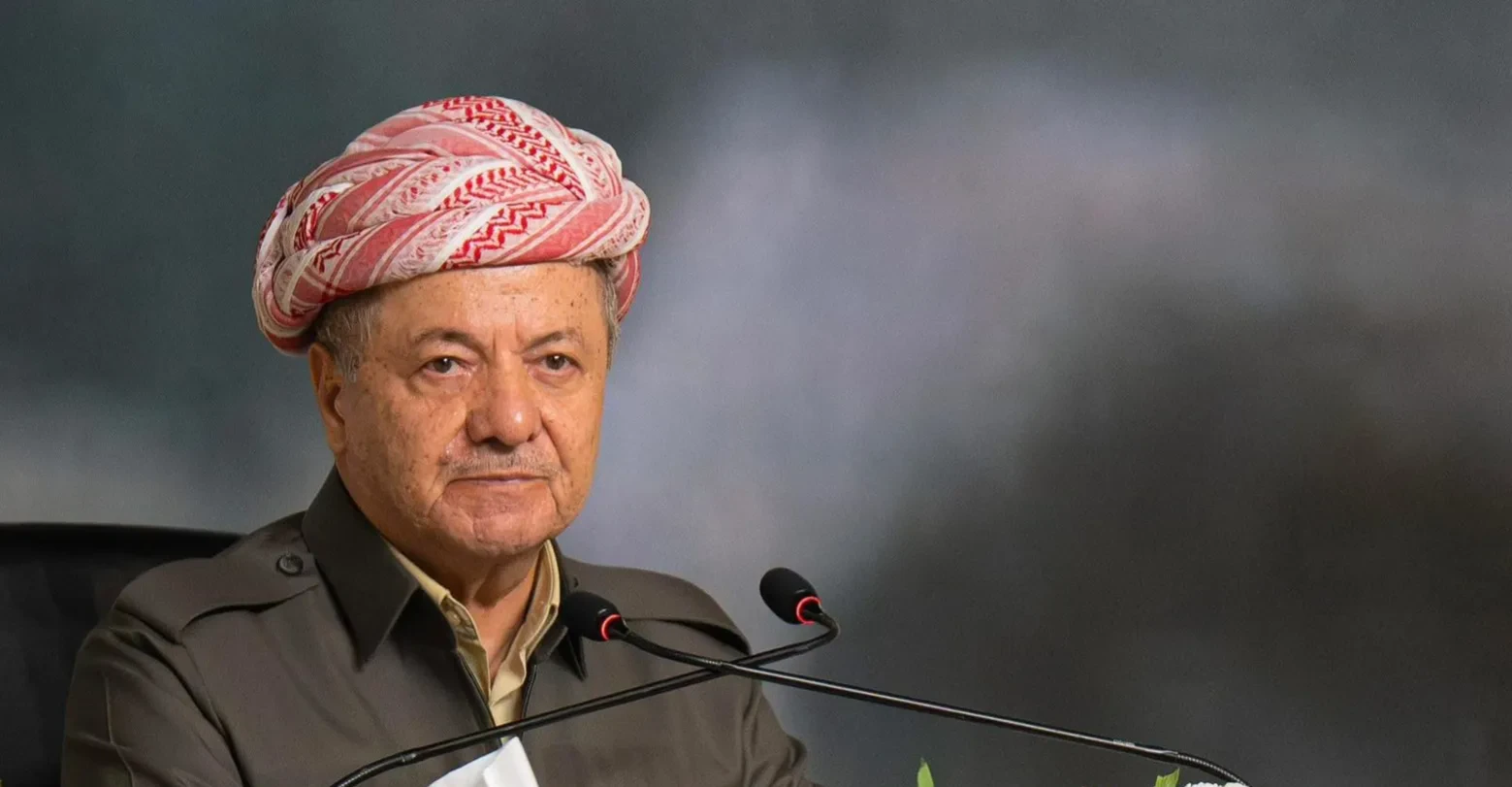 Kurdish leader Masoud Barzani confirmed on Friday that he refuses to proceed with the election of the president of the republic without reaching a simultaneous agreement on the candidate for prime minister.
Barzani said in a tweet on the “X” platform, which was reviewed by Shafaq News Agency, that the insistence of some parties within the coordination framework on proceeding with the election of the President of the Republic, while others continue to fail to decide on a candidate for the Prime Minister, is “unacceptable.”
He pointed out that no constitutional entitlement should be pursued before the issue of the Prime Minister is resolved in conjunction with the election of the President of the Republic, in order to ensure the participation of all political parties in the next session of the House of Representatives.
Earlier today, the Deputy Speaker of the Iraqi Parliament, Farhad Atroushi, objected to the agenda of the session scheduled for Saturday to elect the President of the Republic, saying that proceeding with it in the absence of national and political consensus may deepen the disputes instead of ending the stalemate that has been hindering the formation of the government for months.
Atrushi’s stance comes despite major blocs announcing their intention to attend Saturday’s session. The National State Forces Alliance, led by Ammar al-Hakim, the Progress Party, led by Mohammed al-Halbousi, and several other blocs confirmed the participation of their representatives in the session. The Reconstruction and Development Bloc, supported by Prime Minister Mohammed Shia al-Sudani, also announced its full attendance.
The Iraqi parliament published yesterday, Thursday, the agenda for session number 17 scheduled to be held next Saturday, April 11.
The agenda, which was provided to Shafaq News Agency, included one item related to “electing the President of the Republic,” noting that the session would begin at eleven o’clock in the morning.
The session to elect the Iraqi president comes at a time when the coordinating framework that includes the ruling Shiite political forces in Iraq intends to decide on the position, whether or not an agreement is reached between the Kurdish forces, to whom this position has become allocated.
Iraqi political parties are trying to alleviate the internal pressure they are under, especially after several months have passed since the legislative elections in late 2025, and their failure to form the new Iraqi government.
After the fall of Saddam Hussein’s regime in the spring of 2003 at the hands of US forces and their allies, the major political forces of the Shiites, Kurds, and Sunnis adopted a quota system in distributing positions for the three presidencies: the Prime Minister’s office, the Republic, and Parliament.
The Coordination Framework had officially nominated Maliki on January 24, a move that opened the door to negotiations to form the new government, but the process faltered as disagreements continued over the election of the President of the Republic, the constitutional entitlement that precedes assigning the candidate of the largest bloc to form the government.
Shafaq.com