
Powerful forces are searching for alternatives to Maliki, and the Sudanese alliance is proposing two options for the premiership.
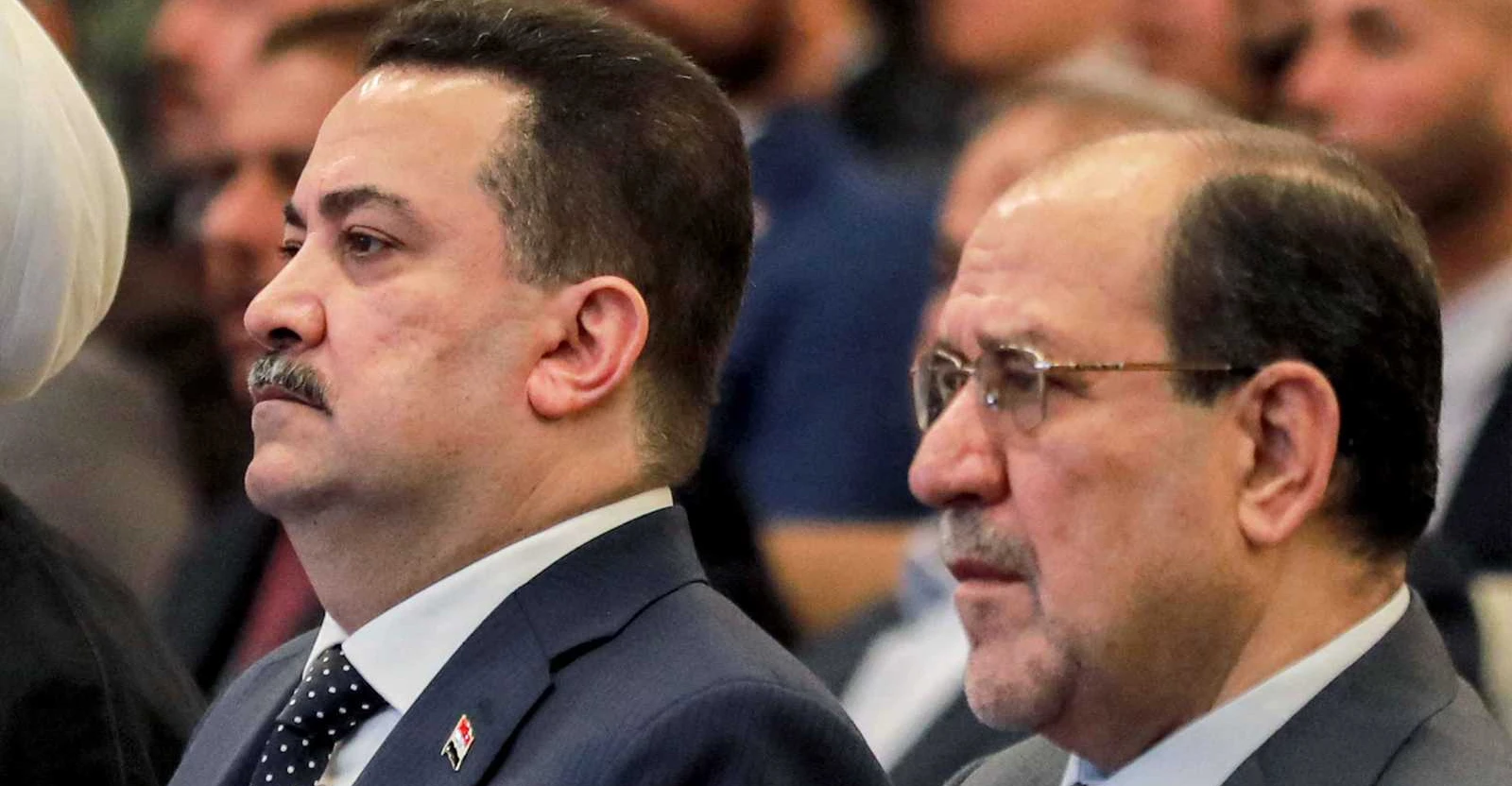 An informed political source reported on Monday that some of the active forces within the Coordination Framework are looking for a candidate to replace Nouri al-Maliki for the position of the next government. While the Framework confirmed its rejection of renewing the mandate of the outgoing Prime Minister, Mohammed Shia al-Sudani, the Reconstruction and Development Alliance put forward two options, with no third, for the leadership of the next government.
The source told Shafaq News Agency that “some of the active forces within the framework are studying a group of names of candidates for the premiership due to the lack of agreement among the framework’s components on a specific candidate after the American veto on the leader of the State of Law Coalition, Nouri al-Maliki, the framework’s official candidate.”
He pointed out that “there is a rejection of the idea of renewing al-Sudani’s term, especially with the arrival of signals from religious leaders who also reject renewal,” indicating that “the coming days will witness intensive activity and continuous meetings to agree on a specific figure acceptable to everyone after vetting the names that will be put forward by some of the influential forces.”
The source continued: “According to the information, if it becomes impossible to pass Mohammed Shia Al-Sudani for a second term, the Reconstruction and Development bloc, which is led by the current Prime Minister, will likely put forward the head of the Reconstruction and Development parliamentary bloc, Bahaa Al-Araji, as an alternative to Al-Sudani, especially since he was a deputy prime minister in a previous government.”
He explained that “the forces of the framework, after agreeing in their meeting last night on the mechanisms for choosing the President of the Republic and setting a final date for the session to name the President, discussed the file of the Prime Ministership in some detail and put forward several names, but one of the active forces in the scene and supporting the renewal of the mandate for Al-Sudani put a veto on all the proposals of the settlement candidates.”
In addition, the spokesman for the Reconstruction and Development parliamentary bloc, Firas Al-Muslawi, confirmed to Shafaq News Agency that “Parliament has set a non-extendable date for the session to name the President of the Republic, and there is a parliamentary agreement to vote on the Kurdish candidate for the presidency if the Kurdish forces agree on one candidate. However, if two candidates are presented for the presidency of the Republic, then the vote under the dome of Parliament is the deciding factor.”
He added that “after the President of the Republic chooses, the latter will task the framework’s nominee to form the government, and we in Reconstruction and Development have no nominee other than Al-Sudani to head the government again, as he achieved success in managing the government.”
Al-Muslawi added: “During the coming period, the Coordination Framework will study several options regarding the candidate for the Prime Ministership, but according to our information, most of the Framework’s forces support renewing Al-Sudani’s second term, as he enjoys acceptance from all parties within the country and international and regional parties. I believe that April 11 will witness the naming of the President of the Republic and the Government in a way that serves the country’s interest.”
Earlier on Monday, the Speaker of Parliament decided to set Saturday, April 11, as the date for holding a session to elect the President of the Republic, calling on the leaders of the political blocs to “bear their responsibilities in completing the constitutional requirements and forming a government capable of facing the challenges.”
The Presidency of the House of Representatives held a consultative meeting Sunday, in which it discussed the ongoing preparations to set a date for a session to elect the new President of the Republic of Iraq during this week in order to end the current political deadlock and proceed with the formation of the next government.
This comes as 220 members of the Iraqi parliament submitted a list of their names and signatures to the parliament’s leadership, demanding that a session be held next Monday to elect the president of the republic.
The coordinating framework that brings together the ruling Shiite political forces in Iraq agreed to postpone deciding on a prime ministerial candidate until after the end of the ongoing regional war between the United States and Israel against Iran, according to a political source who spoke to Shafaq News Agency earlier.
The Coordination Framework had officially nominated Maliki on January 24, a move that opened the door to negotiations to form the new government, but the process faltered as disagreements continued over the election of the President of the Republic, the constitutional entitlement that precedes assigning the candidate of the largest bloc to form the government.
For its part, the framework praised the parliamentary movement to resolve the issue of the presidency, stressing the need to expedite the completion of this constitutional entitlement, and calling on the political forces to resolve it and take advantage of the deadline for holding the session in order to put an end to the state of paralysis.
Shafaq.com