
Al-Maliki divides the coordination framework into three wings, and Al-Amiri seeks to bring them together at a “breakfast banquet”.
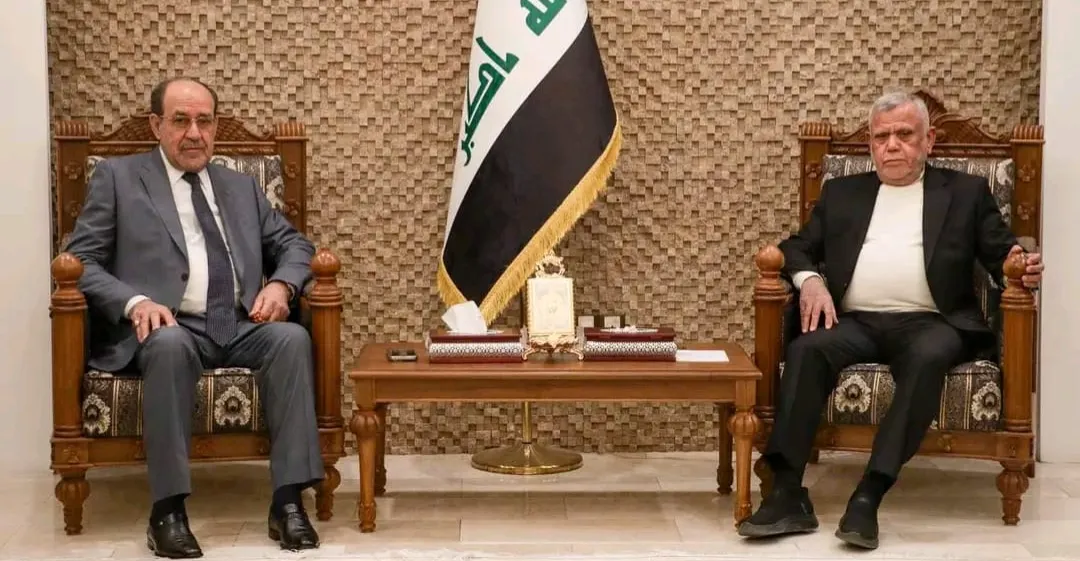 An informed political source revealed on Wednesday that the head of the Badr Organization, Hadi al-Amiri, is making efforts to bring together the leaders of the Coordination Framework and bring them to the negotiating table to resolve the crisis of the candidate for the upcoming government.
Al-Amiri’s attempts come after the escalation of the dispute between the parties within the framework regarding the leader of the State of Law Coalition, Nouri al-Maliki, the candidate for prime minister, around whom disagreements have revolved within the Shiite bloc itself, as well as from partners in the political process, in addition to external pressures, most notably the American ones, which reject al-Maliki assuming the premiership.
The source told Shafaq News Agency, “There are attempts by Al-Amiri to bring together the leaders of the Coordination Framework for an Iftar or Suhoor meal in the coming days to resolve the political dispute and solve the crisis of the prime minister candidate and the formation of the next government.”
He explained that “the coordination framework is currently divided into three wings, one of which includes Nouri al-Maliki, Mohsen al-Mandalawi and Hussein Mounis, another against al-Maliki which includes Ammar al-Hakim and Qais al-Khazali, and a third wing that is currently reserved which includes Hadi al-Amiri, Humam Hamoudi and Mohammed Shia al-Sudani.”
The parties of the coordination framework were supposed to meet on Monday to resolve the disputes and reach a candidate for the next government, but this did not happen due to the lack of convergence of views, according to a source in the coordination framework.
The source told Shafaq News Agency that “most of the forces within the framework had agreed to renew the mandate of caretaker Prime Minister Mohammed Shia al-Sudani, but the insistence of the framework’s candidate, Nouri al-Maliki, on his nomination, along with the rejection by some important parties in the Shiite bloc of renewing al-Sudani’s mandate, thwarted the meeting and no date was set for it to be held again.”
He added: “Official public meetings may be postponed until after the Eid al-Fitr holiday, meaning that internal meetings will continue to reach a final solution after clarifying the reasons for the rejection of the Sudanese renaming by the objecting parties.”
The framework, which is an alliance that includes the largest Shiite forces in parliament, occupies the position of the broadest bloc constitutionally capable of naming a candidate for prime minister after the election of the president of the republic.
Informed political sources told Shafaq News Agency at the time that last Monday’s meeting was to discuss whether Maliki would remain the framework’s candidate or withdraw in favor of another consensus figure, with Maliki to inform the framework’s leaders of his final position during the meeting.
According to the same sources, the meeting was preceded by separate meetings between prominent leaders within the framework, one of which included Ammar al-Hakim, Qais al-Khazali and Muhammad Shia al-Sudani, while another meeting brought together Nouri al-Maliki, Mohsen al-Mandalawi and Humam Hamoudi, and was also attended by the Popular Mobilization Forces leader Abu Fadak al-Muhammadawi, which is a first of its kind.
The participation of Abu Fadak al-Muhammadawi, the chief of staff of the Popular Mobilization Forces, has a special political and security significance, as it comes at the height of the regional confrontation between Iran on one side and the United States and Israel on the other, and with the escalation of American warnings that Iraqi factions loyal to Tehran may expand the circle of targeting inside Iraq, while the American embassy in Baghdad was subjected to a missile attack during the past few days.
The Coordination Framework had officially nominated Maliki on January 24, a move that opened the door to negotiations to form the new government, but the process faltered as disagreements continued over the election of the President of the Republic, the constitutional entitlement that precedes assigning the candidate of the largest bloc to form the government.
Any future prime minister in Iraq will face challenges in managing the balance between Iranian influence and American pressure, as well as the issue of armed factions linked to Tehran.
Pressure on Maliki’s nomination increased after US President Donald Trump announced on January 27 that Washington would not continue to support Iraq if Maliki returned to the premiership, while Maliki later said he would welcome a decision to replace his nomination if it came from the coalition that nominated him.
Shafaq.com