
The National: Sudani’s chances of a second term are “slim”.
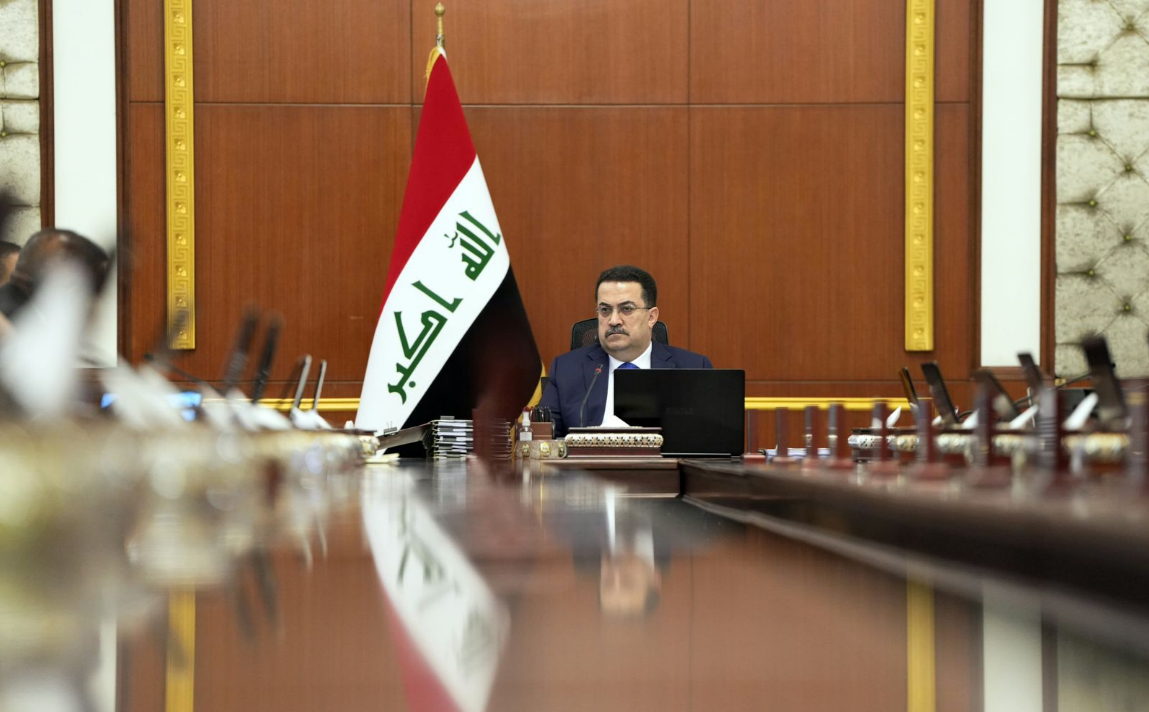 The chances of caretaker Prime Minister Mohammed Shia al-Sudani securing a second term as head of the Iraqi government have become “slim,” according to a report in The National newspaper that discussed the development of heated negotiations between political blocs.
The report, published in English in Abu Dhabi and translated by Shafaq News Agency, noted that the Reconstruction and Development Coalition, led by al-Sudani, came in first place in the recent legislative elections, winning 46 parliamentary seats out of 329.
The report quoted Michael Knights, a researcher at the Washington Institute, as saying that Sudani “was never likely to get a second term because he had few seats and many at the same time.”
He explained that “Sudani has a small number because it requires at least 60 to 70 seats to be able to claim the premiership as a single effort, and a lot of seats because the other Shiite parties want to participate (in choosing) a prime minister who can be controlled and who does not have seats, or almost no seats.”
According to the report, most political parties, especially Shiite ones, are strongly convinced that allowing any prime minister to serve more than one term disrupts the political balance.
The report noted that Nouri al-Maliki’s second term experience raises the possibility of the prime ministership becoming an independent power center capable of establishing a deep political and security network that could override the will of political blocs and threaten their interests, even the political system itself.
At the same time, the report said that some believe that al-Sudani, who is seeking a second term, has likely accumulated experience and networks of influence within state institutions, making him more independent and less susceptible to pressure.
According to this logic, this raises the possibility of the formation of a deep state that extends into the security, economic and foreign affairs sectors, turning the executive authority into a closed system.
The report quoted an unnamed Shiite politician as saying that “so far, al-Sudani does not enjoy the same broad support within the coordination framework as when he was nominated for this position in 2022, and the road ahead is still bumpy.”
According to the same Shiite politician, the coordinating framework is still discussing several candidates to assume the premiership, and it is believed that among the names on the shortlist are the head of the Integrity Committee, Bassem al-Badri, the governor of Basra, Asaad al-Eidani, and the head of the intelligence service, Hamid al-Shatri.
The report quoted Sajjad Jiyad, an expert on Iraqi affairs at the Century Foundation, as saying that the coordinating framework “clearly wants someone who does not have a party, who does not have greater political ambitions in terms of running in the upcoming elections, and someone they feel they will be able to control better.”
Giyad continued, saying, “This type of standard means that al-Sudani is expected to be disqualified.” He added that al-Sudani has “little chance” of securing a second term, noting that he did not achieve a significant majority in the elections, such as winning 70 or 100 seats.
The report quoted a Shiite politician linked to an armed faction as saying, “We cannot deny some of Sudani’s successes in certain areas, but there are also failures,” adding that among them is Sudani’s inclination towards Washington and his willingness to make concessions that could harm the interests of his allies who initially supported him, and this worries us.
According to the same politician, one of the most important conditions for the Sudanese nomination in 2022 was not to build a party base and run in the elections, and “this in itself was a challenge to the partners.”
The report quoted Ina Rudolph, a researcher at the Center for Governance and National Security, as saying that the main red line of the coordination framework is that Sudani has exceeded his ambition to develop beyond the role assigned to him, which is that of “Director General,” referring to a term used by Asaib Ahl al-Haq leader Qais al-Khazali of the Sadiqun bloc in 2022.
According to The National, Rudolph continued, saying that Sudani’s gradual push for a more independent foreign policy, along with his self-promotion as a guardian of Iraq’s stability amid a highly volatile geopolitical conflict, has alarmed entrenched veterans of the Shiite power, such as Maliki.
She explained that these people began to feel an additional threat because of the Sudanese’s relatively higher credibility on the street, which has gained momentum since the municipal elections.
Rudolph believes that despite the challenges facing Sudan, it is seen as a relatively safer option, especially for those who want to keep Iraq out of the regional escalation with Israel and maintain balanced relations with Iran and the United States.
The report quoted Jaber al-Jabri, a political advisor to the Progress Party, as saying that “so far, al-Sudani’s chances are still limited, because there is a strong campaign by al-Maliki to obtain the position, but the final decision depends on the coordination framework.”
He added that the Sudanese are currently part of the coordination framework and “will abide by its instructions and requirements, but the final decision is still unknown.”
The report also quoted an official from the Kurdistan Democratic Party as saying that the party does not oppose al-Sudani’s candidacy for the position, explaining that “we do not have the right to veto anyone. We have been clear with all parties, and our only criterion for supporting any candidate is his commitment to implementing the constitution in its entirety, from A to Z.”
According to the official in the Kurdistan Democratic Party, “The constitution cannot be treated like a restaurant menu, where some items are picked and others are ignored or set aside. Rather, it must be applied fully, fairly, and consistently.”
Shafaq.com