
“Iraq First” is in trouble.. A Western view: Al-Sudani faces victory without authority
 A report by British think tank Chatham House suggests that Prime Minister Mohammed Shia al-Sudani may achieve a significant electoral victory in the November elections. However, this victory will not be enough to retain power, as the position in Iraq is decided through post-election agreements and deals, not through the ballot box.
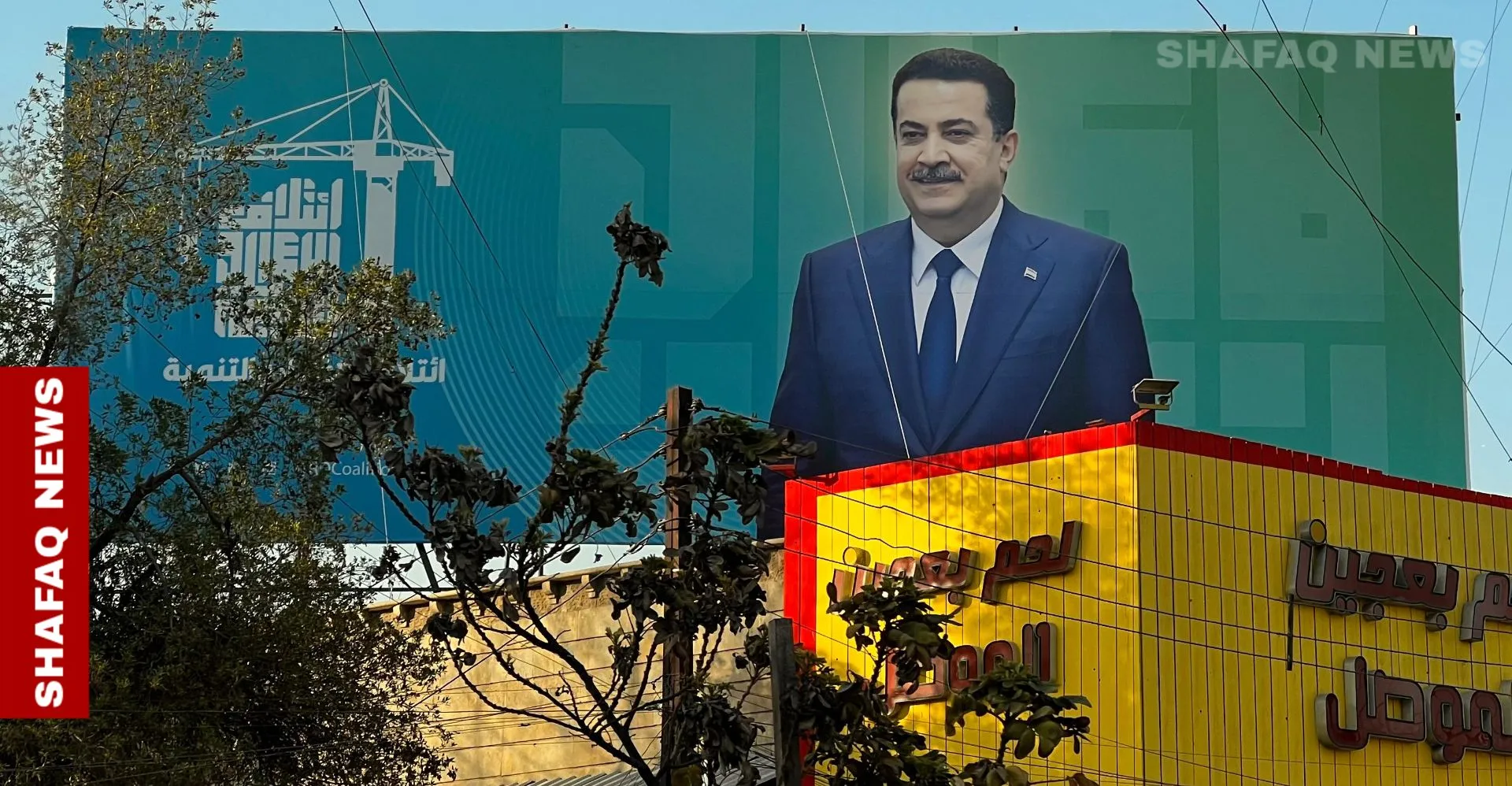
According to a report by the British Institute, translated by Shafaq News Agency, expectations indicate that there will be no significant turnout among Iraqis in the November 11th elections, and that the real competition will be among the elites over power-sharing. The report noted that despite the streets being decorated with election campaign posters, there is little enthusiasm in the air, as many Iraqis are expected to stay home, frustrated that the elections have not brought about change in two decades of democracy.
According to the British report, there is already a broad consensus on the likely outcome of the elections, with Prime Minister Mohammed Shia al-Sudani’s electoral list seen as the favorite, while the ruling Shia-led “Coordination Coalition” is expected to retain power through a consensus government comprising the main Kurdish and Sunni blocs.
However, the report considered that al-Sudani himself would not be able to remain prime minister even if his list won the largest number of votes, as the decision would be made through complex negotiations between the parties to form a government after the elections, as has happened in every previous election where the winner did not become prime minister.
The report continued, noting that despite the expected results, the elections remain contested, with the major blocs spending enormous sums on their campaigns. In this context, it cited statements by former Prime Minister Haider al-Abadi, who stated that the elections “will not depend primarily on popularity. Rather, they will depend on spending money and buying votes.”
The report considered that the reality is that the elections are not a referendum on the government’s performance, but rather an opportunity for the deeply entrenched party elites to recalibrate the distribution of power among themselves, including senior government positions.
According to the report, these inter-party bargaining could prove to be a test of Iraq’s stability, explaining that the country is entering the elections from a rare period of calm, based on a fragile elite pact that has replaced reform with order. If the process proceeds smoothly, it will be a further confirmation that Iraq’s stability will be managed through another round of competition within the system. It points out that if the rival factions perceive an imbalance or attempt to disrupt long-standing arrangements, instability, even momentarily, could disrupt Iraq’s fragile balance.
The report continued, noting that politicians are spending large sums of money, which one expert described during a roundtable discussion at Chatham House as “billionaire elections,” noting that elections have become high-risk investments for elites, where influence and access to state resources are negotiated.
He explained that the restrictions imposed by the United States on the banking sector in Iraq mean that many wealthy individuals are directing their capital toward local projects, including politics, making these elections another lucrative investment opportunity.
The report examined the low turnout rates in the Iraqi elections, which began in December 2005 with a high of 80%, but have been steadily declining, reflecting widespread skepticism that voting can change who governs or how they govern.
He noted that for many Iraqis, the political system does not appear to represent them or respond to their demands. He explained that, two decades after elections and promises of reform, daily life for the majority of Iraqis remains difficult and neglected, that the state is failing, and that despite its vast oil wealth, the country remains among the worst performing countries in providing services and among the most corrupt in the world.
The report noted that the Sadrist boycott of the elections would also contribute to a decline in turnout.
The report considered the fragmentation in the Iraqi elections to be more strategic than ideological, noting that each faction competes separately in an effort to calculate its electoral weight and accumulate bargaining chips for post-election negotiations. It added that once seats are exchanged for positions, these groups converge within their traditional ruling blocs, reassembling the same system of power in a slightly different form.
The report added that this cycle continues, as “the same elite, reorganized and rebranded, returns to power under the familiar pretext of democratic renewal.”
The report stated that Iraq’s post-2003 electoral system was designed to prevent the return of dictatorship, adding that elections were supposed to serve as a rebalancing mechanism, held periodically every four years, and as a means of recalibrating political representation and enabling parties to compete for power peacefully within a constitutional framework.
He added that the goal was also to create pluralism, and that inclusiveness across ethnic and sectarian lines was to protect stability, while the public’s hope was that through elections, Iraqis would be able to hold their leaders accountable.
The report added that two decades later, this system has produced something different. Rather than preventing tyranny, it has fostered a competitive political system in which elections continue. However, democracy and accountability are eroding, and the very institutions established to uphold democratic standards, transparency, and the rule of law have been hijacked or politicized by the same elite.
The report ruled out a comprehensive reform of the Iraqi political system in the near term, adding that the Coordination Framework is expected to continue to guide government formation and maintain its central role in determining the prime minister and executive positions within the government.
As for the Sadrist movement, the report predicted it would likely maintain “one foot inside and one foot outside” the regime, and would have sufficient influence to shape the outcome, but would be far from claiming opposition status.
As for the major Kurdish and Sunni parties, they will attempt to recoup what they lost during the last government formation process and secure a greater share of power.
Therefore, the report stated that “rebuilding trust requires addressing Iraq’s democratic deficit at its core and then restoring the link between elections and accountability.” Furthermore, Iraq will need electoral laws that give votes real value, through clearer mechanisms for allocating seats, transparent vetting of candidates, enforcement of laws related to campaign and political party financing, and protection of the Electoral Commission from political control. This will also require strengthening the oversight capacity of the House of Representatives, enabling committees to effectively audit budgets, monitor ministries, and question senior officials without partisan impediments.
While noting that such steps require political will, the report cautioned that without structural reform, Iraq’s elections will remain arenas for elite competition rather than tools for citizens to hold to account.
He added that the elections will continue to reflect the appearance of a democratic choice, but without its substance. He emphasized that true reform can ensure that Iraqi democracy begins to deliver on its previous promises, not just by reorganizing power, but by restoring trust.
Shafaq.com