
Will reconciliation succeed? The National reports: The split between the two Kurdish parties threatens the region’s influence in Baghdad.
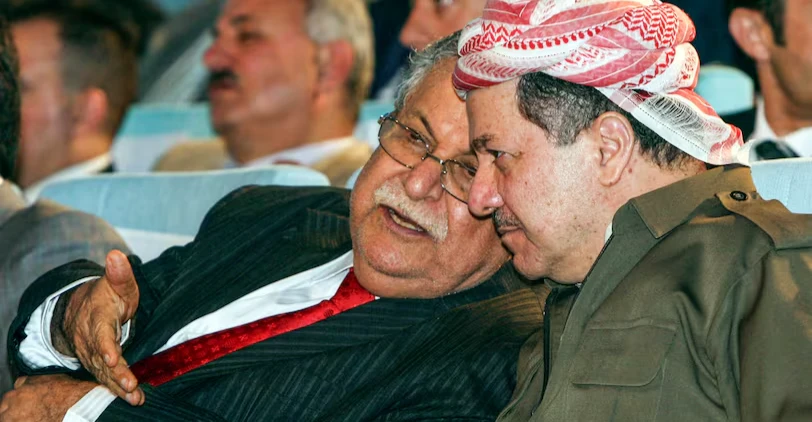 The National newspaper warned that the continued political confrontation between the Kurdistan Democratic Party and the Patriotic Union of Kurdistan could weaken the Kurdistan Region’s influence in Baghdad, amid fears of a return to two separate administrations, but it noted that opportunities for a settlement still exist, including the possibility of the Patriotic Union reversing its decision to withdraw from the regional government.
The English-language newspaper published in Abu Dhabi, in a report translated by Shafaq News Agency, said that the withdrawal of the Patriotic Union of Kurdistan and the decision of the Democratic Party to proceed with the election of the parliament’s leadership brought back memories of the confrontations that the region witnessed during the 1990s, when its administration was divided between two rival leaderships.
Although the possibility of a renewed split has become a major concern, analysts believe that the legal and political circumstances are different today than they were then, and that both sides have much more to lose than they would with a formal split, despite continued doubts about their ability to reach a settlement.
The report reviewed the historical roots of the dispute between the two parties, which dates back to the collapse of the Kurdish uprising in 1975, when the position of the Kurdistan Democratic Party, led by Mustafa Barzani, declined following the signing of the Algiers Agreement between Iraq and Iran, which ended Tehran’s support for the Kurdish fighters.
The two parties later developed separate political and military structures, amid competition for influence within the Kurdish national movement and the territories they sought to govern.
The report quoted Mohammed Saleh, a researcher at the Foreign Policy Research Institute, as saying that the Patriotic Union of Kurdistan (PUK) is seeking to regain its political strength after more than a decade of internal conflicts and divisions by adopting a more confrontational stance towards the Kurdistan Democratic Party (KDP) in order to strengthen its local position, especially in light of its competition with smaller opposition parties for voters’ support in Sulaimaniyah and Halabja.
He noted that Kurdish leader Masoud Barzani recently called on all political parties to support the reactivation of parliament, stressing that this step “was not directed against any person or any party.”
For her part, Shayan Talabani, an analyst at the Tony Blair Institute, believes that the split comes at a difficult time for the Kurdistan Region, both internally and regionally, following the withdrawal of US forces, the war in the region, the growing influence of Baghdad, and the uncertainty in Turkey, Syria and Iran, particularly with regard to Kurdish interests.
Constitutional obstacles to partition
The report addressed the legal complexities that any attempt to divide the Kurdistan Region might face, explaining that Article 117 of the Iraqi Constitution recognizes the region as an existing federal entity, while Article 119 specifies the procedures for forming new federal regions from one or more governorates, but the Constitution and the 2008 Law on the Formation of Regions do not explicitly address the issue of governorates separating from an existing federal region .
In this context, Saleh explained that Sulaymaniyah and Halabja’s attempt to separate from the Kurdistan Region, without being recognized as an independent federal region, could lead to them becoming two governorates subject to ordinary administration, with far fewer powers than they currently enjoy.
The report quoted an official from the Kurdistan Democratic Party as saying that the federal government officially deals with the Kurdistan Region as a single constitutional entity, and that dividing it could raise broader complications related to the Iraqi federal system and open the door to renewed demands for the formation of other regions.
The official explained that allowing the emergence of a separate region from within Kurdistan could encourage similar demands in other areas of Iraq, including Basra, Anbar and Nineveh.
For her part, Shayan Talabani considered that Erbil would remain, in practice, the center of any legitimate Kurdish administrative authority at the present time.
Winthrop Rodgers, a researcher at Chatham House, pointed out that the legal and procedural implications of the division are still unclear, explaining that Article 119 provides a constitutional path to forming a new federal territory, but its application to the case of secession from an existing territory would be subject to legal dispute.
The Kurdistan Democratic Party official ruled out the possibility of a formal division of the region, saying he was fully convinced that it would not happen, for reasons related to the constitutional framework, the will of the people, Baghdad’s position, and international dynamics.
He added that international partners and neighboring countries realize that a unified and stable Kurdistan Region serves regional security, economic cooperation and political stability better.
The report referred to an interview given a few days ago by the head of the Patriotic Union of Kurdistan, Bafel Talabani, in which he ruled out a renewal of violence and refused to portray the dispute as a family feud between the Talabani and Barzani families, stressing that it is a long-standing political dispute between two political forces, and describing what happened in parliament as “the straw that finally broke the camel’s back.”
Who benefits from the division?
According to the report, the repercussions of the crisis extend beyond the relationship between the two parties, as the continued division will weaken the ability of the Kurdish leadership to exert influence in Baghdad, where the Democratic Party and the Patriotic Union have traditionally competed for positions and negotiated the constitutional and financial rights of the Kurdistan Region.
Shayan Talabani observed that the increasing personalization of political practice, attempts to concentrate power within parties, and the rise of a new generation of leaders also contributed to weakening Kurdish unity in Iraq.
For his part, Mohammed Saleh described the current divisions as representing “an opportunity and a major headache for Baghdad,” explaining that some influential political factions in the federal government welcome a weaker Kurdish leadership, particularly those seeking to expand central control over the region.
Rodgers warned that a divided Kurdistan region would be less able to defend the principle of Kurdish autonomy, as well as the legal and constitutional powers associated with it.
He explained that Baghdad seeks to control sovereign powers and financial flows, but does not necessarily want to assume responsibility for the day-to-day management of the region’s institutions. However, the paralysis of these institutions could push federal authorities to take on a larger role, including the potential direct payment of public sector salaries—an idea that has been raised repeatedly during discussions between the federal and regional governments.
Is reconciliation possible?
Despite the intensity of the confrontation, the report indicated that both sides have strong motives to reach a negotiated settlement, as Mohammed Saleh believes that the Patriotic Union of Kurdistan’s withdrawal from the government is not an irreversible decision, and that the Democratic Party’s move to reactivate parliament was an attempt to end the stalemate that lasted for about two years.
Saleh believes that the way out of the crisis lies in reaching a new and comprehensive power-sharing agreement that brings the two parties together, improves the government’s performance, and strengthens the Kurdish position in Baghdad.
Rodgers agreed with this view, noting that the two parties would benefit from a framework that would allow them to cooperate politically, economically and in terms of security, rather than separate, especially since Kurdish citizens oppose division, while leaders could achieve political gains from reaching a serious agreement.
However, he ruled out the possibility of reaching such an agreement being very likely at the present time, given the wide divergence between the positions of the two sides, the weak desire for reconciliation, and the absence of effective American mediation.
Rodgers said Washington was “not interested in mediation,” adding that the parties would not have responded to it anyway.
In contrast, the official in the Kurdistan Democratic Party expressed optimism about the possibility of overcoming the crisis, acknowledging that the differences between the two sides are significant, but not impossible to resolve, and stressing that “what unites us is much stronger than what divides us.”
Shafaq.com