
Syrian-Iraqi trade is recovering… Oil and transit open a new route
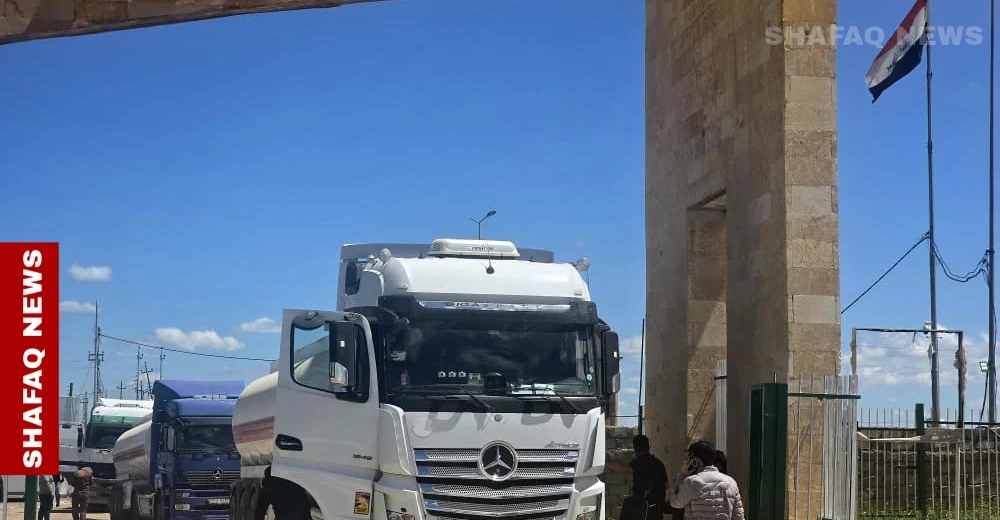 Trade between Syria and Iraq is gradually recovering, with the return of activity at border crossings and the emergence of new routes in the energy and transit sectors, amid expectations of increased trade in the coming months.
Louay Al-Ashqar, a member of the board of directors of the Damascus Chamber of Commerce, told Shafaq News Agency that the current volume of trade between Syria and Iraq is still modest and does not reflect the available potential, noting that trade through the Al-Qaim-Al-Bukamal crossing used to reach about one billion dollars annually before 2011.
Al-Ashqar explained that Syria at that time provided between 60 and 80% of Iraq’s imports of food, clothing and medicines, while Syrian exports to Iraq amounted to $58 million in 2024 and $62 million in 2025.
He added that “the current low level of trade is not related to a decline in demand, but rather to the closure of border crossings and the repercussions of the war, at a time when Iraq relies heavily on imports to meet its needs.”
Al-Ashqar continued, saying that Syrian exports to Iraq are currently concentrated in vegetables and fruits, food industries, clothing and textiles, plastics, medicines and detergents. In contrast, Syria used to import dates, date paste and wheat from Iraq, while the exchange is currently witnessing a remarkable shift towards the energy sector.
He pointed out that Iraq began in April 2026 to transport fuel oil and crude oil by truck through Syrian territory to the port of Banias for re-export, at a rate of up to 900 trucks per day, in a move aimed at bypassing the Strait of Hormuz. He indicated that four sectors are poised for rapid growth in the coming period: agriculture and food industries, pharmaceuticals and plastics, building materials and reconstruction, in addition to the energy and transit sector, which he described as the most important, with the possibility of turning Syria into a corridor for exporting Iraqi oil to the Mediterranean.
Regarding the digital targets for trade exchange, Al-Ashqar pointed out that there is no official figure announced by the two governments so far, explaining that there has been an agreement since the beginning of 2026 to open the import and export of all materials according to the principle of reciprocity.
According to the Syrian official, the Iraqi border authority expected that the opening of the “Rabia – Yarubiyah” border crossing would lead to an increase in trade exchange of between 10 and 20% during the first few months, while it is expected that trade will gradually return to much higher levels than the current ones.
According to Al-Ashqar, traders face three main obstacles: the frequent closure of border crossings, the failure to register Syrian companies in Iraq, and the absence of official banking channels, which forces traders to resort to unofficial remittances, in addition to the high costs of production in Syria. He added that the obstacles are not limited to the customs aspect, but are distributed across three axes: the first is customs and regulatory and relates to specifications and company registration; the second is logistical and relates to the closure of border crossings and the high costs of transportation and insurance; and the third is financial as a result of the absence of banking links.
He noted that steps have been taken to speed up the movement of trucks, including the reopening of the Al-Qaim-Al-Bukamal crossing in June 2025, where more than 7,000 trucks have crossed since its reopening. He explained that the recent reopening of the Rabia-Al-Yarubiyah crossing aims to relieve pressure on other crossings and speed up the movement of trade.
He also pointed to the expansion of unloading capacity at the port of Banias, in addition to opening offices for the Iraqi SOMO company, stressing that there is a trend towards simplifying documents and reducing fees, noting that the agreement on the principle of reciprocity represents the basis for this.
He concluded by saying that the Iraqi side announced that operating the Rabia crossing would reduce waiting times and logistical costs, but so far no new unified fee schedule has been issued. He pointed out that traders have begun to see partial results since last June with the return of truck traffic, but tangible and significant results remain linked to the continued opening of the two crossings, achieving security stability, and simplifying procedures.
On Friday, July 17, Iraq and Syria, under US auspices, signed a memorandum of understanding to rehabilitate and operate the Kirkuk-Banias oil pipeline, which had ceased operations due to damage sustained during the US invasion of Iraq in 2003.
The agreement and memorandum of understanding were signed in Washington, D.C., between the Basra Oil Company and the Syrian Petroleum Company, in the presence of U.S. Energy Secretary Chris Wright and Iraqi Prime Minister Ali al-Zaidi. The U.S. company Chevron, through an international consortium, will manage the technical and financial aspects of the rehabilitation project.
The Iraqi market is considered one of the most important foreign markets neighboring Syria, due to its large economic size and strong geographical and social ties between the two countries.
On August 5, an Iraqi trade delegation, including members of the Baghdad Chamber of Commerce and businessmen, discussed with the head of the Federation of Syrian Chambers of Commerce, Alaa Al-Ali, at the Federation’s building in Damascus, ways to expand economic cooperation and open new horizons for joint investment between the two countries.
Osama al-Qadi, the senior advisor to the Syrian Ministry of Economy and Industry, told Shafaq News Agency on May 22 that “the Iraqi market represents a strategic opportunity for the Syrian economy, as Damascus and Baghdad seek to strengthen cooperation and trade partnership in a way that serves the interests of both countries and contributes to the development of national economies in the medium and long term.”
The Iraqi-Syrian border crossing of Al-Qaim is considered one of the important gateways for trade between the two countries, as the volume of trade through it reached one billion dollars during 2024, according to statistics from the Iraqi-Syrian Business Council.
Sfaq.com