
A Turkish report outlines the Zaidi equation: Washington for investment, Tehran for balance, and Ankara for development.
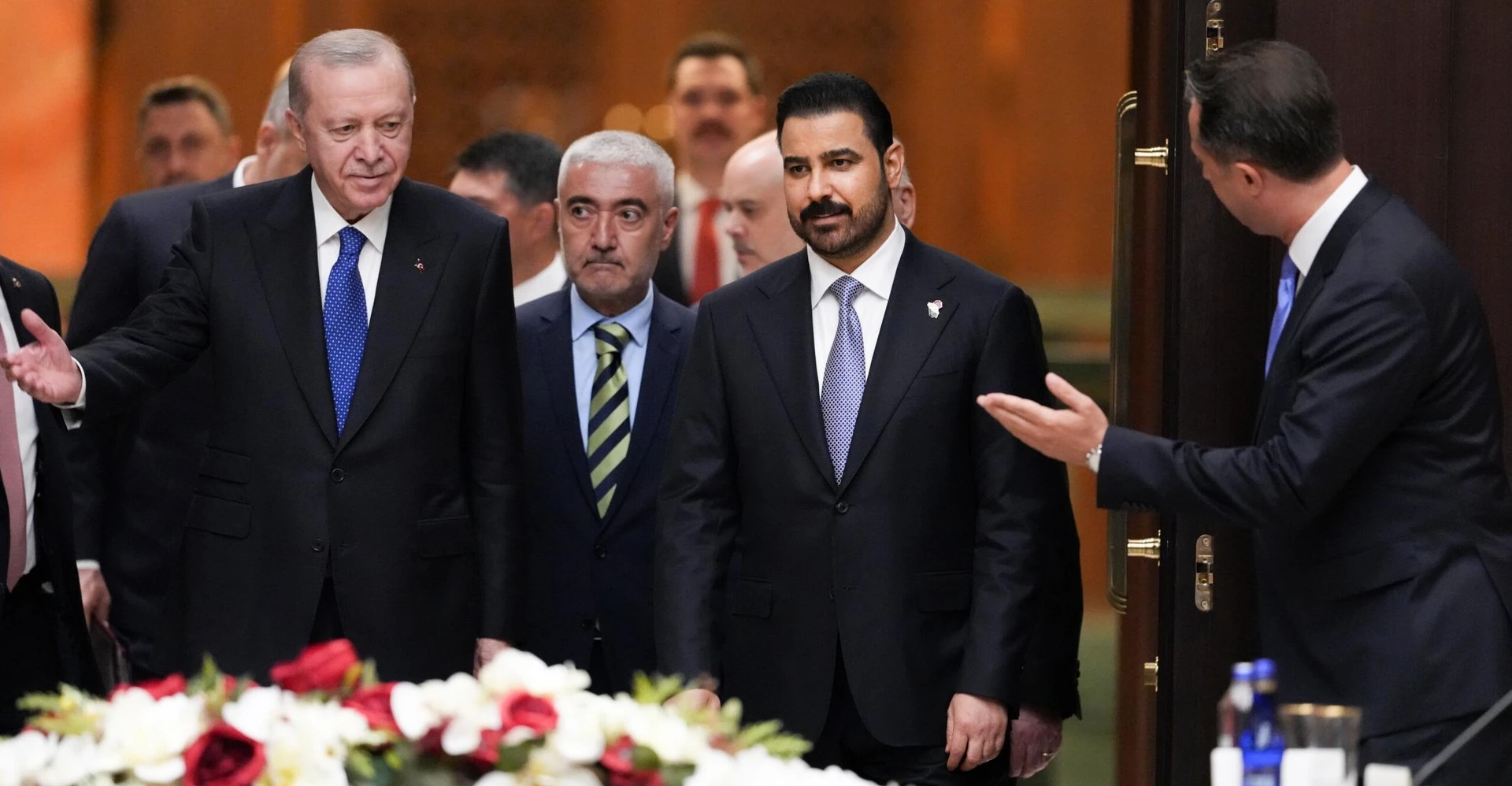 A Turkish report outlines the Zaidi equation – Washington for investment – Tehran for balance and Ankara for developmentShafaq News – Translation
The successive and rapid visits of Iraqi Prime Minister Ali al-Zaidi to Washington, Tehran and Ankara are considered “important” in terms of demonstrating the new government’s approach to foreign policy, according to the Turkish website ” Politics Today ,” which believes that al-Zaidi’s moves show his pursuit of investment from the United States, political balance from Iran, and economic ties from Turkey.
“Politics Today” said in a report translated by Shafaq News Agency that, for Iraq, Washington and Tehran are two capitals closely linked in terms of security, capital, historical influence, and developments in Iraqi domestic politics, while Ankara, on the other hand, represents the most realistic, stable, and reliable economic route through which the country can access global markets.
The Turkish website argued that for this reason, al-Zaidi’s visit to Ankara immediately after his engagements in Washington and Tehran should not be seen as merely a visit to a neighboring country, as this visit shows that Baghdad, which has placed economic development at the heart of its government program, does not view Turkey only as a trade partner, but as a strategic gateway in the equation of production, transportation and energy in Iraq.
The report noted that the most important aspect of al-Zaidi’s talks in Ankara was not the number of documents signed, but rather what they addressed in terms of the needs of Iraq and Turkey, recalling that five memoranda of understanding were signed covering educational and academic cooperation, youth and sports, industrial property, rail and road transport via the Fishkhabur-Ovakoy border crossing, and the development of transport infrastructure in Iraq in exchange for natural resources.
The report explained that while the first three agreements represent an expansion of the social and institutional basis of the relationship, the last two agreements have direct strategic importance to Iraq’s economic future, because they strengthen the links necessary to move the “Development Road” project, which aims to link the Grand Faw Port in Basra to the Turkish border and from there to Europe, to the implementation phase. IraqTravel Guide
The report continued that al-Zaidi’s visit shows that the new Iraqi government is maintaining the strong relations that have been established between Iraq and Turkey in recent years, recalling that during President Recep Tayyip Erdoğan’s visit to Baghdad in April 2024, 27 legal texts were signed, while 11 documents were signed at the High-Level Strategic Cooperation Council meeting held in May 2025.
He added that “the fact that al-Zaidi included Ankara in his first foreign itinerary since taking office indicates that Türkiye has secured a permanent place in Iraq’s development plans.”
After noting that Iraq has been producing oil for many years, but has not been able to adequately control the routes through which this oil is transported, the report explained that a large percentage of oil revenues depend on exports through the southern ports and the Strait of Hormuz, which means that any military tension in the Gulf directly becomes a problem for the Iraqi budget. It added that this confirms the real importance of the “Development Corridor,” which, if successful, will achieve more than just transporting containers from Basra to Turkey. It will also establish new industrial zones, logistics centers, energy networks, and urban development areas along the route. Given the number of young people in Iraq and the high unemployment rate, this transformation will provide an alternative to the limited job opportunities currently available in the oil sector alone.
According to the report, Turkey plays a role in this equation that no other neighbor of Iraq can easily fulfill, explaining that while Iran is linked to Iraq through energy, trade and political networks, and the Gulf states can provide capital to Iraq, Turkey is the only direct neighbor capable of linking Iraq to the European market by land and rail, and to the Mediterranean Sea via Ceyhan.
In addition, the report stated that building the economic foundation between the two countries will not be from scratch, noting that the volume of trade between Turkey and Iraq reached about $17 billion in 2025, while Turkish companies implemented more than 1,000 projects in Iraq with a total value of about $40 billion.
But the report noted that the Saudi-American airstrikes that occurred immediately after the visit to Ankara demonstrated the fragility of the security environment in which the development diplomacy being carried out by al-Zaidi, who cancelled his visit to Riyadh, was taking place. It added that within days, Iraq, which had been discussing transport corridors and economic integration in Ankara, was once again drawn into the military arena of US-Iranian tensions.
The report considered that such a development does not diminish the importance of the Ankara visit, but rather, on the contrary, enhances it, explaining that Iraq’s way to rid itself of regional military competition does not lie solely in maintaining balanced relations with Washington and Tehran, adding that Iraq must raise the cost of conflict by developing its economic ties, thereby forcing countries to back down from engaging on its territory.
He went on to explain that it is difficult to claim that the trade, energy and transport networks that will be established with Turkey will provide Baghdad with an absolute security guarantee, but these links will make Iraq’s stability more valuable to Turkey, Europe, the Gulf States and international companies.
The report noted that economic interdependence alone would not prevent war, but it would help Iraq move away from being seen solely as a country defined by militias, military bases, and spheres of influence.
The report concluded by saying that, given al-Zidi’s initial foreign policy moves, he is seeking investment from Washington, political balancing from Tehran, and economic ties from Ankara. However, of these three capitals, Turkey stands out for offering the most viable path to transforming Iraq’s geography into an economic advantage by operating the roads extending north.
He concluded by saying that the real issue is not the signing of the five documents in Ankara, but whether the pipeline running from Ovakoy to Faw, the oil flowing from Kirkuk to Ceyhan, and the $30 billion commercial target will make the Iraqi state stronger and more independent.
Shafaq.com