
Between Trump and Pezeshkian… Al-Zaidi maneuvers: What has he achieved for Baghdad?
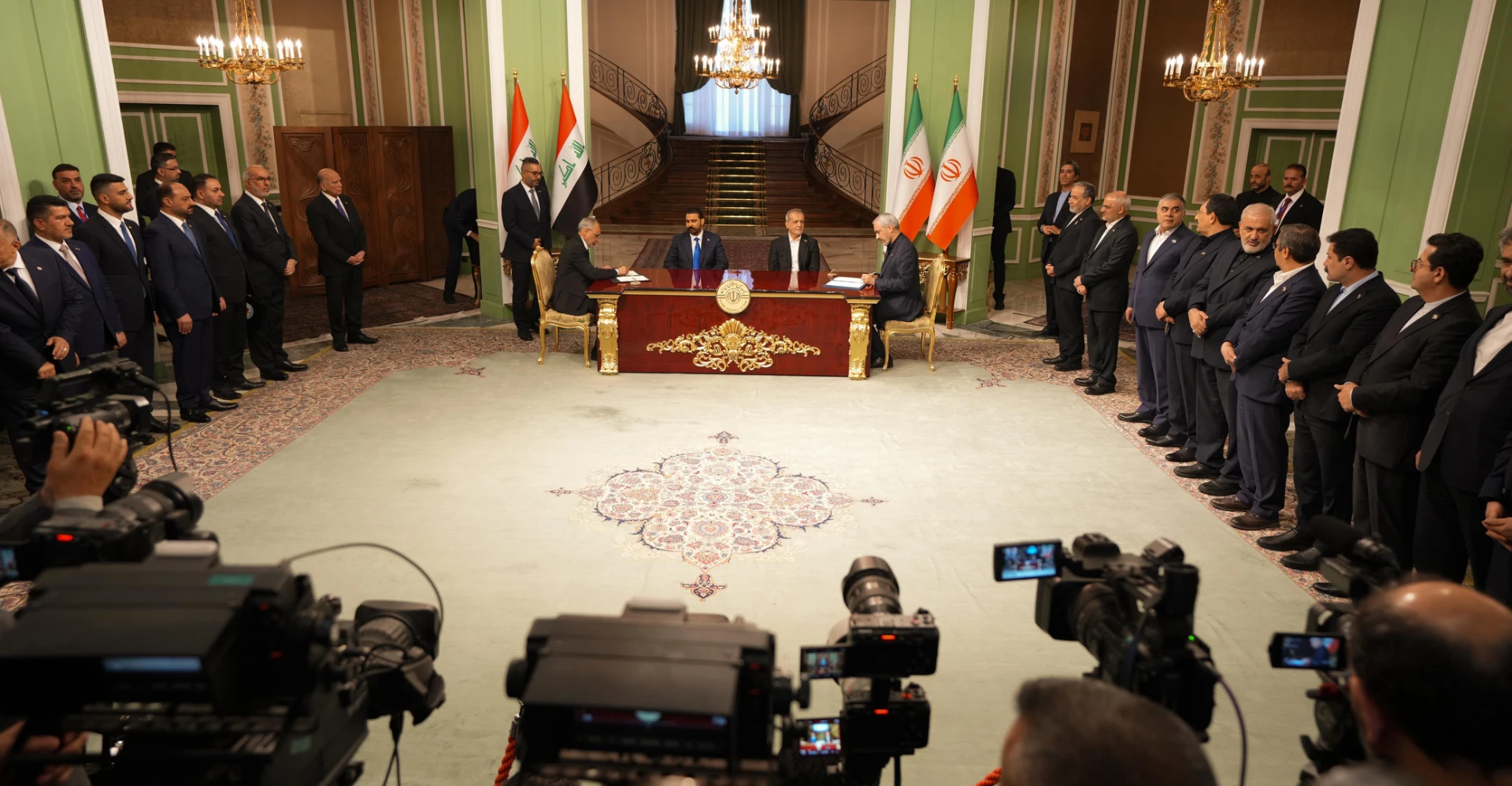 During his visit to the Iranian capital, Tehran, on Thursday, Iraqi Prime Minister Ali Faleh al-Zaidi carried with him multiple political, security, and economic files, in his second foreign stop after his visit to Washington, which focused on economic, investment, and energy issues.
The one-day visit, which included meetings with Iranian President Masoud Pezeshkian and several senior Iranian officials, came amid escalating tensions between the United States and Iran, and Baghdad’s attempts to maintain a delicate balance between its strategic ally in Washington and its neighbor Iran.
During the talks, Al-Zaydi stressed that “Iraq and Iran’s security is shared,” emphasizing that Baghdad will not allow any threat targeting Iran to originate from Iraqi territory, while calling for expanding investments and strengthening economic cooperation between the two countries.
The visit also resulted in the signing of a number of agreements and memoranda of understanding in the fields of transport, railways, training and management, including an agreement on international freight shipping and transport, a memorandum on railway linking Kermanshah, Khosravi and Khanaqin to Baghdad, as well as a twinning memorandum between Baghdad and Tehran, and another for the development of government administration and human resources.
Observers believe that the most prominent aspect of the visit was Iraq’s attempt to establish its position as a party capable of communicating with various regional and international powers, amid increasing talk of a possible Iraqi role in bringing Washington and Tehran closer together.
Baghdad mediation
In this context, Professor of International Relations Saleh Al-Shadhar believes that the visit comes at a stage that is witnessing a reshaping of the regional system, considering that Iraq will be an important player in the next stage.
Al-Shadhar told Shafaq News Agency that “a regional Arab system is forming, and Iraq will have a major role in leading it,” noting that the Middle East is witnessing transformations led by the United States within an international system with a unipolar tendency.
According to the professor of international relations, Al-Zaidi has a role that US President Donald Trump described as being significant for Iraq, considering that the Tehran visit could lead to important results in terms of Iraqi foreign policy.
According to Al-Shadhar, one of the goals of the visit is to convey reassuring messages to the Iranian side regarding the possibility of returning to the path of negotiations with Washington, including previous agreements, the nuclear program and ballistic missiles, or reaching a truce that allows for discussion of outstanding issues.
He asserts that Iraq’s partnership with the United States under the 2008 Strategic Framework Agreement, along with its historical ties with Iran, gives it an opportunity to play a mediating role acceptable to both sides.
Tehran Files
For his part, Iranian affairs expert Mehdi Azizi believes that talk of an Iraqi role in mediating between Washington and Tehran preceded the visit, whether through statements by Iraqi officials or through media discussions in Iran and the United States.
Azizi explained to Shafaq News Agency that “Trump wanted to give al-Zaidi the role of mediator between Iran and America to bring them back to the negotiating table,” noting that Iraq has direct motives to engage in this path, given the impact of any escalation on its security and economy.
He adds that the Strait of Hormuz file is one of the most prominent issues on the table, as the continued disruption of navigation or the closure of the strait will directly affect the Iraqi economy and oil exports.
He also indicates that economic relations between Baghdad and Tehran, and the American messages that al-Zaidi is believed to be carrying to Iranian officials, were among the issues discussed.
He also points out that the issue of armed factions in Iraq is one of the most sensitive issues, explaining that Washington has demanded that weapons be restricted to the state, and that part of the discussions may address the possibility of pushing Tehran to influence the factions that refuse to hand over their weapons.
He says the visit represents al-Zaidi’s “second stop” after Washington, which gives it special importance in light of the entanglement of regional issues including Syria, Lebanon, and the future of Iraqi-American relations.
De-escalation
Independent politician Abu Mithaq al-Masari believes that the most prominent aspect of the Tehran visit is the attempt to reduce tensions between the United States and Iran.
Al-Masari told Shafaq News Agency that “an important part of the Iraqi Prime Minister’s visit to Iran will be dedicated to containing friction between the American and Iranian sides,” noting that cooling down contentious issues and postponing some outstanding points may open the door to new understandings.
Al-Masari notes that returning to the memorandum signed between the two parties represents an important goal to spare the region, and Iraq in particular, the repercussions of any military confrontation.
He points out that Iraq’s good relations with both sides of the crisis give it a greater opportunity than others to play a mediating role, noting that Al-Zaidi’s visit to the White House was immediately followed by his visit to Tehran, which, in his estimation, reflects a desire on both sides to benefit from the Iraqi role in reducing escalation.
Economic dimension
For his part, Hassan Fad’am, a leader in the Wisdom Movement, links the visits to Washington and Tehran, considering that Iraq’s external movement aims primarily to provide a stable environment that supports the economy and development.
Fadaam told Shafaq News Agency that Al-Zaidi’s visit to the United States focused on moving Iraqi-American relations from a security and military framework to an economic, investment and development partnership.
This shows that implementing these projects requires a safe environment and political and economic stability, which is what prompted Baghdad to try to ease tensions between Washington and Tehran.
He affirms that Iraq, by virtue of its geographical location and its relations with Iran, is capable of conveying messages and contributing to dialogue processes, noting that Iraqi foreign policy focuses on protecting stability and preventing the country from becoming an arena of conflict between regional and international powers.
Limits of mediation
In contrast, Ashraf Akka, an international relations expert from Ramallah, believes that Baghdad’s ability to prevent a large-scale escalation between Washington and Tehran faces significant challenges due to the nature of the conflict itself.
Akka told Shafaq News Agency, “I don’t believe that the Iraqi Prime Minister’s visit to Iran alone can prevent Iraq and the region from sliding into a wider confrontation,” explaining that the region is experiencing a phase of alignments that go beyond the limits of the traditional Iranian-American dispute.
He adds that Iraq faces an internal challenge in the differing positions of political forces and factions regarding the nature of the relationship with the United States, noting that the success of any foreign policy requires internal national consensus.
It shows that the current conflict is not limited to a confrontation between Tehran and Washington, but is related to redrawing the balance of influence and the geopolitical and economic balances in the region.
He emphasizes that the ability of any Iraqi prime minister to achieve a genuine balance requires an internal national dialogue capable of managing divisions over the war and regional alliances.
Outcomes of the visit
In addition to the political issues, Al-Zaidi’s visit had a clear economic dimension, as the joint Iraqi-Iranian statement confirmed the agreement to prepare a comprehensive strategic document to enhance cooperation between the two countries in the political, economic, cultural and security fields.
The two sides also agreed to enhance trade and joint investments, develop cooperation in the fields of energy, transport, transit, industry and agriculture, as well as accelerate the implementation of railway linkage projects.
One of the most prominent projects that has been emphasized is the railway link between Iraq and Iran, which is expected to enhance the movement of goods and passengers, and support Iraq’s position as a regional trade corridor.
The statement also included strengthening cooperation in addressing environmental challenges, particularly drought, dust storms and water resource management, as well as expanding security coordination in combating terrorism, organized crime and smuggling.
Shafaq.com