Beyond the statements: Messages from the Trump-al-Zaidi meeting at the White House
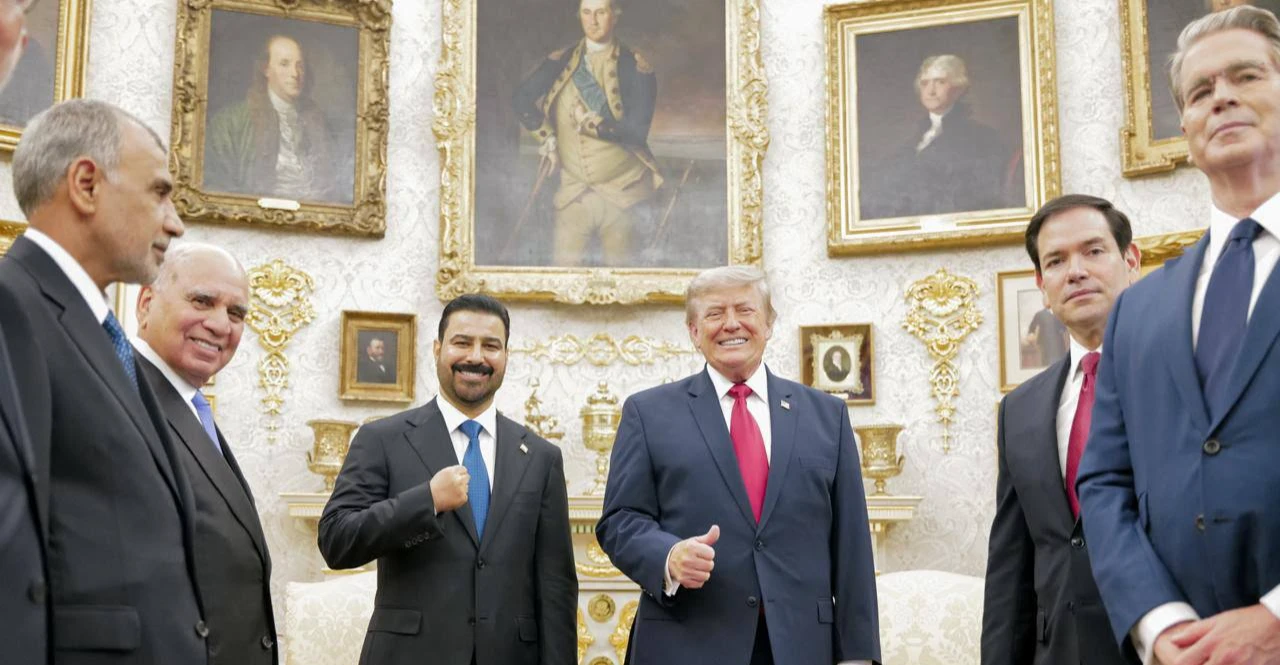 In a meeting that carried multiple political, economic and security messages, US President Donald Trump received Iraqi Prime Minister Ali al-Zaidi at the White House on Tuesday evening, Baghdad time, in his first foreign visit since assuming the premiership, amid complex regional circumstances, most notably the renewed tension between the United States and Iran, and escalating fears of a wider confrontation in the region.
The meeting that brought the two sides together in the Oval Office was not just a protocol stop in Iraqi-American relations, but rather seemed to be an attempt to redefine the nature of the relationship between Baghdad and Washington, by moving from a phase that focused on the security and military file to a new phase that puts the economy, energy and investment at the forefront of priorities, while the files of weapons and regional influence remain strongly present on the table of discussion.
During the joint press conference, Trump announced that the United States does not see a need for a continued American military presence in Iraq, stressing that the next phase will depend on a broad economic partnership, especially in the oil sector, while Al-Zaidi stressed that his country is moving towards ending the mission of the international coalition in exchange for opening the door for American companies to invest in Iraq.
But behind the diplomatic language, the meeting addressed more sensitive issues, most notably the future of armed factions, the relationship with Iran, energy security, and the future of Iraq’s role in a region witnessing increasing tensions.
New partnership
During the meeting, the US president stressed that the relationship with Baghdad is entering a different phase, noting that the United States supported Iraq during the war against ISIS, but no longer sees a need for its forces to remain militarily in the country.
Trump said that “there is no need for an American military presence in Iraq,” while emphasizing Washington’s readiness to support Iraq’s security when necessary.
He noted that the United States and Iraq are moving towards a strong partnership in the oil sector, announcing that American energy companies will enter Iraq at levels he described as “unprecedented,” and that next week will witness the announcement of a major oil partnership and extensive trade deals between the two countries.
Trump also described Iraq as a country rich in resources and oil reserves, arguing that the next phase should invest these capabilities in strengthening economic cooperation.
The US president did not hide his political support for al-Zaidi, saying that he was interested in him becoming prime minister, considering that his rival was adopting inappropriate positions towards Washington (referring to Nouri al-Maliki).
Trump described al-Zaidi as a “great leader,” expressing his belief that he would remain in office for a long time, and said that Iraq was undergoing a transformation in its relationship with the United States.
Energy Hub
The energy file occupied a large part of the White House discussions, given Baghdad’s desire to attract American companies to develop the oil and gas sector, increase production and improve infrastructure.
Al-Zaydi said that Iraq wants a strong economic partnership with the United States, and that the end of the American military presence will be met with the entry of American companies into the Iraqi market.
He stressed that the relationship between the two countries should be based on economic and social ties, and not just on military cooperation.
He explained that Iraq, as one of the founding members of OPEC, demands a fair share of oil production commensurate with its capabilities, noting that the country paid a heavy price during the war on terror, which left widespread damage to the infrastructure.
Simultaneously with the White House meeting, Iraqi Oil Minister Bassem al-Abadi discussed in Washington with the president of the American company Chevron, Jake Sperring, opportunities to expand cooperation in the oil and gas sectors, develop production, and benefit from global expertise and technology.
This comes as part of a government initiative to attract major energy companies, diversify oil export outlets, and reduce the risks associated with dependence on the Strait of Hormuz.
The factional dilemma
The issue of armed factions was one of the most sensitive issues during Al-Zaidi’s visit, as the Iraqi Prime Minister confirmed that his government is proceeding with the implementation of the decision to restrict weapons to the state.
Al-Zaydi said that the Iraqi security forces have become capable of protecting the country, and that the phase following the end of the international coalition’s mission at the end of next September will witness full reliance on Iraqi security capabilities.
He added that the government had received quantities of weapons from some factions, and that it would continue to work with those who choose to engage in the political process, stressing that it would not allow any party to carry weapons outside of official institutions.
He explained in his statements that “there is no need for any factions after the end of September,” stressing that the state’s decision is to end the duality of weapons.
Washington had made it clear before the visit that it would assess its position based on “measurable actions and results,” not just political pledges, indicating that the issue of the factions would be a key criterion in evaluating the future relationship with Baghdad.
In this context, Ihsan Al-Shammari, head of the Center for Political Thought and professor of strategic and international studies at the University of Baghdad, believes that this issue will be central to the Washington talks.
Al-Shammari told Shafaq News Agency that regional developments will push the United States to take a tougher stance against Iranian influence and armed factions, noting that the US administration will demand swift action from al-Zaidi. Dailynews reports
He adds that the Prime Minister is facing mutual pressure between Washington on one hand, and the political forces and factions on the other, noting that the challenge before him is to achieve a balance that allows for the implementation of his government program.
Iran file
Iran was not absent from the meeting, as Trump described Tehran as a “great burden” on Iraq, noting that the region had gotten rid of, in his words, an entity that had been a source of pressure.
He also spoke about the US measures against Iran and the sanctions targeting it, stressing that Washington had given Tehran opportunities to reach an agreement but had responded to what he described as Iranian escalation.
These statements coincided with Trump’s announcement that his administration is working to include Iran and the Lebanese Hezbollah in a sanctions bill linked to the sanctions imposed on Russia.
In this regard, political researcher and advisor to the former Iraqi Prime Minister, Ayed Al-Hilali, believes that the regional dimension gives Al-Zaidi’s visit greater importance than just the bilateral relationship.
Al-Hilali told Shafaq News Agency that the escalating tension between Washington and Tehran, along with developments in Yemen and the Red Sea, presents Iraq with a difficult test in managing its balancing policy.
He continues, saying that Baghdad is required to protect its interests with the United States without engaging in a policy of alliances, warning that an escalation of the confrontation could raise the bar for American demands towards Iraq.
Internal debate
Inside Iraq, the visit faced objections from some factions and political forces who warned against the nature of the new relationship with Washington.
In this regard, Abdul Rahman al-Jazaeri, a leader in the Coordination Framework (which brings together the ruling Shiite political forces in Iraq), says that the escalation in the Gulf and the targeting of American bases further complicates the situation, noting that some factions still object to the monopoly on weapons and to economic and political openness with the United States.
Al-Jazaeri adds to Shafaq News Agency that Iranian-Iraqi relations have political, economic and ideological dimensions, and that any American pressure on Baghdad may affect these relations.
He points out that the future of the American presence in Iraq remains unclear, and that the visit is not only related to the economy, but also to Iraq’s position in major regional transformations.
In contrast, Abbas Al-Aqabi, a specialist in legal affairs and international agreements, believes that Al-Zaidi’s visit does not mean that Iraq is siding with one party at the expense of another.
Al-Aqabi told Shafaq News Agency that the visit came at the invitation of the US President, and that it included multiple files related to the economy, energy, investment, agriculture and industry, stressing that Iraq seeks to build balanced relations with Washington and Tehran.
He concludes at the end of his speech that the issue of restricting weapons came within the government program, and that the goal of cooperation with American companies is to provide an investment environment that the country needs, especially with the limited internal financial capabilities.
Shafaq.com