
Cautious anticipation… What awaits Iraq after the US-Iran agreement?
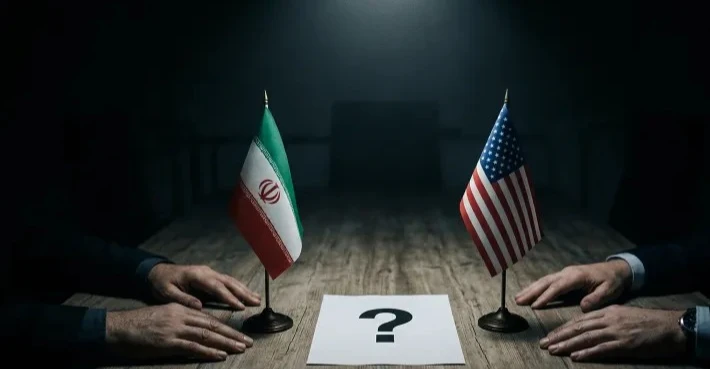 While political assessments in Baghdad and the region’s capitals race to read what might result from the recent US-Iranian understanding, the Iraqi scene seems closer to a gray area that oscillates between optimism about the possibility of capitalizing on the breakthrough, and cautious waiting until it becomes clear whether the agreement will actually hold on the ground or remain a fragile political framework that is susceptible to shaking at the first regional test.
This ambiguity is further compounded by the complexities of the Iraqi scene itself, where political, security and economic issues are intertwined with an extensive regional and international network of influence, making Iraq one of the countries most affected by any shift in the relationship between Washington and Tehran, whether in terms of internal stability, power balances, or even regional energy and trade routes.
According to initial announcements, the “peace agreement” between the United States and Iran, mediated by Pakistan, includes a cessation of military operations, the reopening of the Strait of Hormuz to international navigation, the lifting of the naval blockade on Iran, and the opening of a path for nuclear negotiations within 60 days.
Although the executive details are still incomplete, the mere announcement of it on Sunday night/Monday morning has begun to affect market expectations and regional powers’ assessments, in an early indication that its potential repercussions will not remain confined to Washington and Tehran, but will necessarily affect countries, foremost among them Iraq.
Iraq and regional conflicts
In this context, political analyst Imad Al-Musafir, who is close to the coordination framework, says that Iraq is “within a region teeming with conflicts, and it is certain that any escalation or stability in this region will have a negative and positive impact on the Iraqi interior, especially given the significant economic and political ties between Iraq and the countries of the region.”
The traveler adds to Shafaq News Agency that what is required today is “a clear vision for the Iraqi political decision-maker regarding what is happening in the region, and to employ it correctly in a way that serves Iraqi interests, and not at the expense of national constants and principles held by the Iraqi people.”
Conditional opportunity
In contrast, Dr. Ihsan Al-Shammari, Professor of Strategic and International Studies at the University of Baghdad and Head of the Center for Political Thought, believes that Iraq may be one of the most prominent countries to benefit from ending the state of war between Washington and Tehran, given the magnitude of the direct effects that this confrontation has on the Iraqi interior.
Al-Shammari told Shafaq News Agency that Iraq “was one of the countries most affected by the military operations between America and Iran, and the accompanying political, diplomatic and economic repercussions,” adding that the agreement “represents an opportunity for Ali al-Zaidi’s government to rearrange the cards, especially at the political level, towards a roadmap for reforming the state and its institutions and putting forward a national project.”
On the economic level, Al-Shammari, speaking to Shafaq News Agency, points out that previous tensions, especially those related to the Strait of Hormuz, have affected oil revenues, but he sees the current easing of tensions as an opportunity that should be invested more deeply by “diversifying the routes for exporting Iraqi oil through Saudi Arabia, the port of Yanbu, Jordan, Syria and even Turkey, which would allow for pumping approximately 1.4 million to 1.5 million additional barrels.”
He adds that “the issue is not just about increasing revenues, but about restructuring the Iraqi economy according to the realities of the war that took place.”
From a security standpoint, Al-Shammari believes that the agreement could constitute “a supporting document for the principle of restricting weapons to the state, as there is no justification for any weapons remaining outside the framework of the state,” noting that the next stage may push the government to move forward with the issue of armed factions within broader understandings with Tehran.
But Al-Shammari warns at the same time against being satisfied with traditional approaches, saying that this “will not bring Iraq any more benefit,” noting that even Iraqi-American and Iraqi-Gulf relations “were damaged during the previous stage, and that today the opportunity is ripe to rearrange them quickly.”
Caution and vigilance
Despite the positive atmosphere that accompanied the announcement of the agreement, Dr. Haitham Al-Hiti, a professor of political science at the University of Exeter in Britain, calls for greater caution in interpreting the current stage.
Al-Hiti told Shafaq News Agency, “No one knows how solid the agreement is or its ability to become a reality,” adding that “the agreement is still fragile and unclear, and came after many political maneuvers and compromises.”
He believes it is too early to talk about decisive repercussions for Iraq, whether positive or negative, noting that “the next stage will be determined not only by the American-Iranian relationship, but also by the American role within Iraq.”
He adds that the American agenda being managed by envoy Tom Barrack inside Iraq “will be more influential than the course of the relationship between Washington and Tehran,” explaining that the measure of developments in Iraq “will be linked to the American role and the plan that Barrack will implement, and to how the Iraqi political forces respond to this shift in light of the pressing economic reality.”
Multiple gains
For his part, writer and political analyst Ali Al-Baydar believes that the agreement opens a new window for Iraq that could turn into a lasting gain if it is properly utilized.
Al-Bader told Shafaq News Agency that Iraq “could be one of the regional countries most positively affected by the agreement, given its geopolitical location and its relations with the parties involved.”
He points out that the previous phase, especially since the events of October 7, 2023, imposed dual American and Iranian pressures on Iraq that made the “political compass unstable,” adding that any breakthrough may alleviate internal polarizations and disparities in political loyalties.
Economically, Al-Bader expects that stability will enhance the investment environment and increase confidence in the Iraqi economy, while in terms of security, he believes that the agreement will likely lead to “a decrease in mutual attacks and a reduction in the use of Iraqi territory as a battleground,” giving security agencies an opportunity to focus on issues such as combating terrorism.
Shafaq.com