
The framework authorizes al-Zaydi to handle the weapons file and supports severing the Popular Mobilization Forces’ ties with political frameworks.
 On Monday evening, the Coordination Framework authorized Prime Minister and Commander-in-Chief of the Armed Forces Ali al-Zaidi to take decisions and measures “that would preserve the country’s higher interests,” while announcing its support for the project to restrict weapons to the state and to separate the Popular Mobilization Forces from political, partisan, and social frameworks.
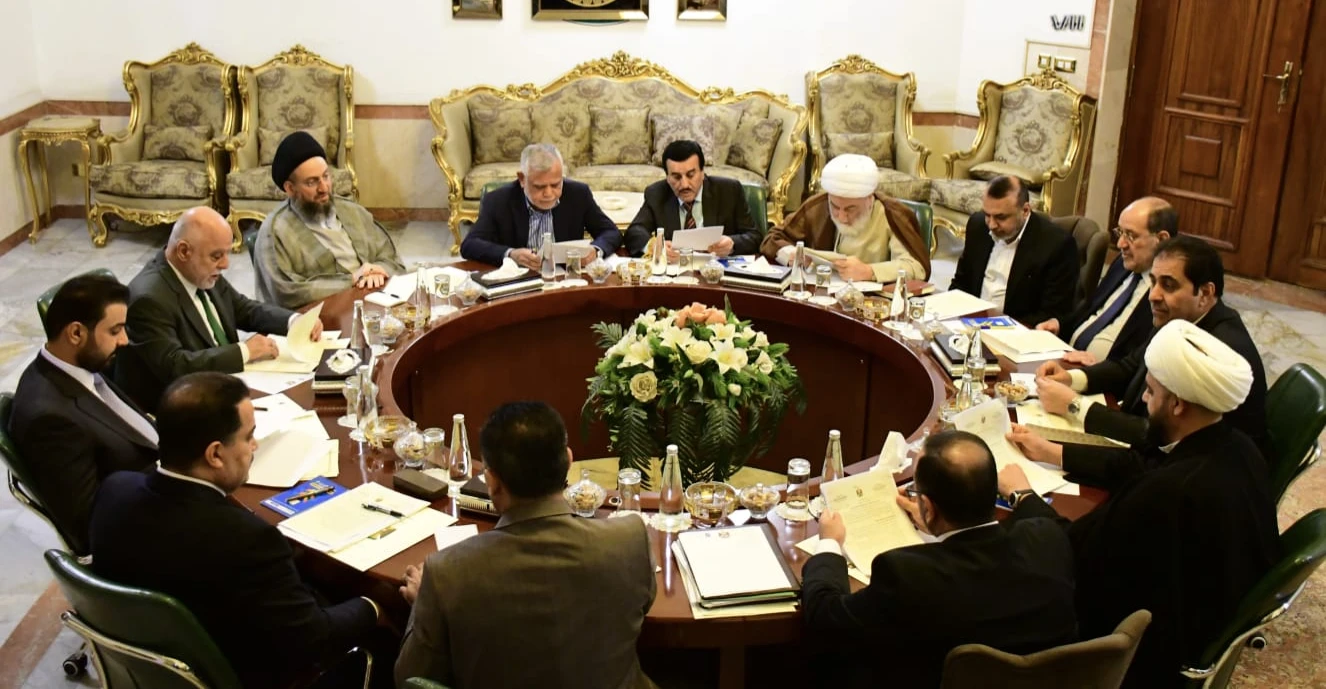
The framework stated in a statement received by Shafaq News, following its 279th regular meeting held at the office of former Prime Minister Haider al-Abadi, in the presence of Prime Minister Ali al-Zaidi, that the meeting discussed “a number of priority national and security files.”
He stressed that the choice of the political system and its representatives is “an exclusive right of the Iraqi people,” who, he said, have made “great sacrifices in defense of their state and democratic system,” emphasizing that the decision of war and peace is “a sovereign national decision that belongs to the Iraqi people through their constitutional institutions, represented exclusively by the House of Representatives and the elected government.”
The statement considered that “any action outside this framework is a violation of the law and the principles of the constitutional state.”
Regarding the Popular Mobilization Forces, the Coordination Framework affirmed that the organization is “an official security institution committed to the constitution, applicable laws, and the orders of the Commander-in-Chief of the Armed Forces, and carries out its duties in accordance with the approved legal frameworks.”
According to the statement, the leaders of the framework announced their support, “out of a sense of national responsibility, for the project of restricting weapons to the state and separating the Popular Mobilization Forces from all political, partisan, and social frameworks, based on the Iraqi constitution, the directives of the supreme religious authority, the Popular Mobilization Forces Law No. 40 of 2016, as well as the ministerial program that was voted on by the House of Representatives in the session to grant confidence.”
The statement also linked this step to the desire to continue cooperation between the Iraqi government and the international community, and to complete the process of ending the mission of the international coalition in Iraq.
The framework added that its forces authorized the Prime Minister, Commander-in-Chief of the Armed Forces, to “take the decisions and measures necessary to preserve the supreme interests of the country,” according to the statement.
The framework’s position comes days after the leader of the Shiite national movement, Muqtada al-Sadr, announced the disassociation from the “Peace Brigades” and their integration into the state, a move that was welcomed by the newly formed Iraqi government headed by al-Zaidi.
Most of the current armed factions trace their roots back to the period after 2003, when formations emerged linked to the security vacuum that followed the American invasion of Iraq, before expanding significantly after ISIS invaded large Iraqi cities in 2014.
On the international front, the United States is intensifying its pressure on Baghdad, as an informed political source revealed to Shafaq News Agency on Sunday that al-Zaidi received a message from the American side that included Washington’s categorical rejection of the participation of any armed faction in the new Iraqi government, even if those factions announce that they will give up their weapons or leave military action.
According to the source, the American message stressed that assigning any ministerial portfolio or high-ranking government position to an armed faction or to figures representing those factions would be met with an American and Western rejection, and could lead to a political and administrative break with the ministry concerned, which would affect Iraqi-American relations and cooperation with other Western countries.
Shafaq.com