
Among them are “military sanctions”… The Iraqi government issues directives to restrict weapons to the state.
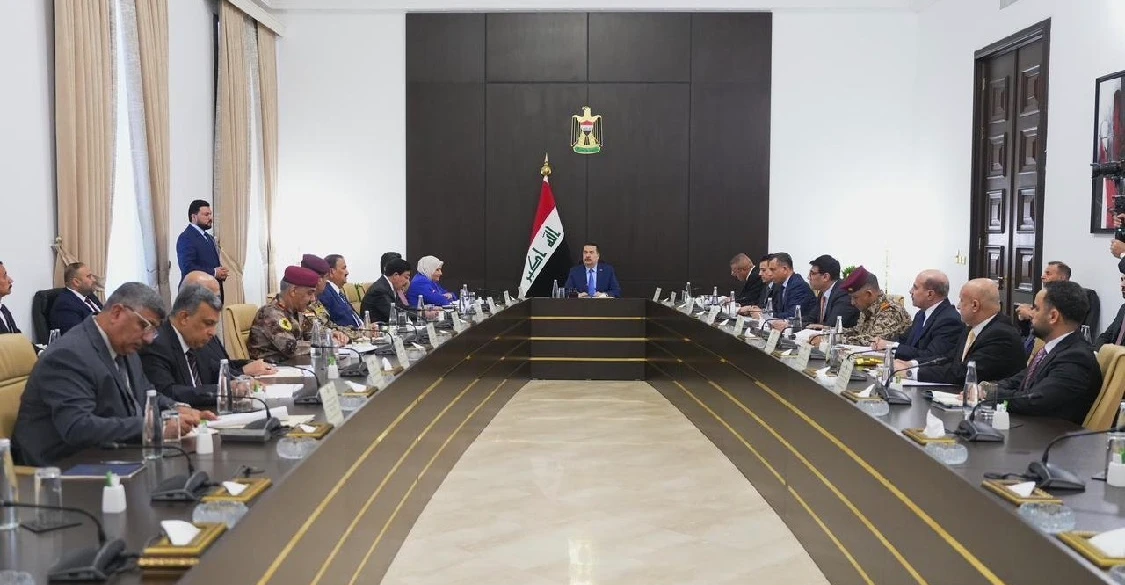 On Monday, the Commander-in-Chief of the Armed Forces, Mohammed Shia al-Sudani, issued decisions regarding restricting weapons to the state and taking firm measures against outlaws, as well as military penalties against those who fail in their duties from the security forces.
The spokesman for the Commander-in-Chief of the Armed Forces, Sabah al-Nu’man, said in a statement received by Shafaq News Agency that “the Prime Minister (outgoing) Commander-in-Chief of the Armed Forces, Muhammad Shia’ al-Sudani, chaired today the third periodic meeting of the Ministerial Council for National Security for the year 2026.”
He pointed out that “during the meeting, the overall security situation in the country was discussed, and the topics on the agenda were considered, and the necessary decisions and recommendations were made regarding them, including the report on monitoring sources of terrorism financing, importing anti-aircraft systems, and keeping Iraq neutral from the course of the regional conflict.”
He explained that “the attendees discussed regional developments, security, political and economic challenges, and the government’s commitment to protecting Iraq’s sovereignty and consolidating security and stability through integrated measures at the security, administrative and diplomatic levels.”
According to Al-Nu’man, the council affirmed “Iraq’s right to defend itself and prevent any attempt to target or use its territory. As a result of these discussions, a number of important recommendations were emphasized, including security and military measures, restricting weapons to the state, and taking decisive measures against outlaws.”
The Council decided to “take the necessary security, military and legal measures to prevent any attack on neighboring countries from Iraqi territory, or any attack on diplomatic missions, and to confront any entity operating outside the framework of the state, while pursuing the perpetrators of these acts without exception, in order to ensure the protection of Iraq’s security and sovereignty.”
Regarding administrative procedures, the Ministerial Council decided to “dismiss and hold accountable the offending parties and elements or those involved in illegal acts and refer them to the judiciary.”
Regarding the protection of diplomatic missions, the Council stressed that “any infringement on the security and safety of diplomatic missions and facilities is unacceptable and against the law, and the government will take firm military, security, legal and administrative measures against the perpetrators of these acts, in order to preserve the sovereignty of the state and the prestige of its institutions.”
The Council affirmed that “targeting neighboring countries from Iraqi territory is considered a terrorist act, and this description applies to any act targeting diplomatic missions operating in Iraq.”
In the file of strengthening diplomatic efforts, the Council decided to “intensify communication and diplomatic coordination with neighboring countries and countries of the region, in a way that enhances reducing tensions and consolidating regional stability, and enshrines the approach of dialogue and understanding as a basic option, and in a way that ensures the protection of Iraq’s supreme interests and strengthens its regional position.”
He stressed the need to “strengthen mechanisms for exchanging information and security assessments, in order to support joint efforts to combat cross-border threats, and to unify relevant regional and international efforts in confronting security challenges, and to enhance cooperation based on respect for sovereignty and common interests.”
The Council stressed “the need for neighboring brotherly and friendly countries to refrain from using their territories as a launching pad for attacks on Iraq, or from violating its territorial sovereignty, the sanctity of its airspace and waters.”
At the conclusion of the meeting, the Ministerial Council for National Security affirmed that “protecting the state requires decisive decisions and proactive measures, and that integration between security, administrative and diplomatic work represents a national necessity to maintain stability, strengthen the economy, and preserve Iraq’s regional and international standing.”
The participants stressed “preventing any military action against any party whatsoever within Iraqi territory, and that Iraq is responsible for its own security and no party has the right to interfere in its affairs.”
Shafaq.com