
A split within the framework into three factions, and Maliki confronts the objectors with a new condition.
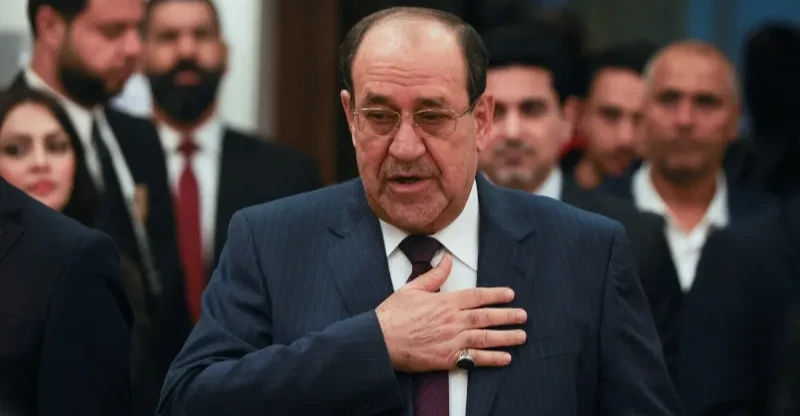 An informed political source revealed on Wednesday that escalating divisions within the coordination framework are threatening the convening of the anticipated meeting to decide on the name of the prime minister candidate, amid sharp differences among its leaders regarding the figure who will assume the position in the next phase.
These disputes come at a time when the government formation process has entered a critical constitutional phase, following the election of Nizar Amidi as President of the Republic on April 11, and the obligation of the largest parliamentary bloc to present its candidate for the premiership within a maximum period of 15 days.
The source told Shafaq News Agency that the disagreements within the framework are no longer limited to differing viewpoints, but have developed into an actual split within the alliance into three main wings, which has cast a shadow over today’s meeting scheduled to be held at Humam Hamoudi’s house, with growing doubts about the possibility of postponing it to another date.
According to the source, the first faction insists on nominating the leader of the State of Law Coalition, Nouri al-Maliki, or any figure who enjoys his explicit support from among the proposed names, while the second faction is pushing for the renaming of the caretaker Prime Minister, Mohammed Shia al-Sudani, while the third faction prefers to go for a compromise candidate who can gain wider acceptance within and outside the Shiite bloc.
He added that the leaders decided to put a list of names on the meeting table, including Nouri al-Maliki or someone who has his support, Mohammed Shia al-Sudani, Basim al-Badri, Ali Youssef al-Shukri, Hamid al-Shatri, Abdul-Ilah al-Naili, and Mohsen al-Mandalawi.
This dispute is more sensitive because al-Maliki was originally put forward as an official candidate for the Coordination Framework for the Prime Ministership, before the calculations became complicated later due to internal objections and external pressures, most notably the American position rejecting the establishment of a government that it sees as subject to Iranian influence, which reshuffled the cards within the framework and prompted some of its parties to reopen the search for alternatives or a compromise candidate.
For his part, Abu Mithaq al-Masari, a member of the coordinating framework, told Shafaq News Agency that the problem was no longer limited to the name of the candidate, but extended to the method of withdrawing al-Maliki’s nomination itself.
According to Al-Masari, Al-Maliki insists that those who oppose his nomination submit individual requests signed with their names, thus clearly holding each party politically responsible. Meanwhile, leaders within the framework who reject his return insist that the withdrawal request be collective and under the title of the Coordinating Framework, in order to avoid turning the crisis into a direct personal confrontation with him.
The scene is becoming more complicated with the continuation of mutual boycotts within the framework, as Shafaq News sources reported earlier that a meeting scheduled for this week was postponed due to a boycott by some leaders, while a small meeting held at al-Maliki’s house discussed the agenda of the next meeting and the nominated names, with the addition of Ali al-Shukri’s name to the list of contenders, at a time when Basim al-Badri is emerging as one of the most prominent settlement candidates.
Shafaq.com