
A battle intensifies in Iraq following the election of Amidi, amid divisions.
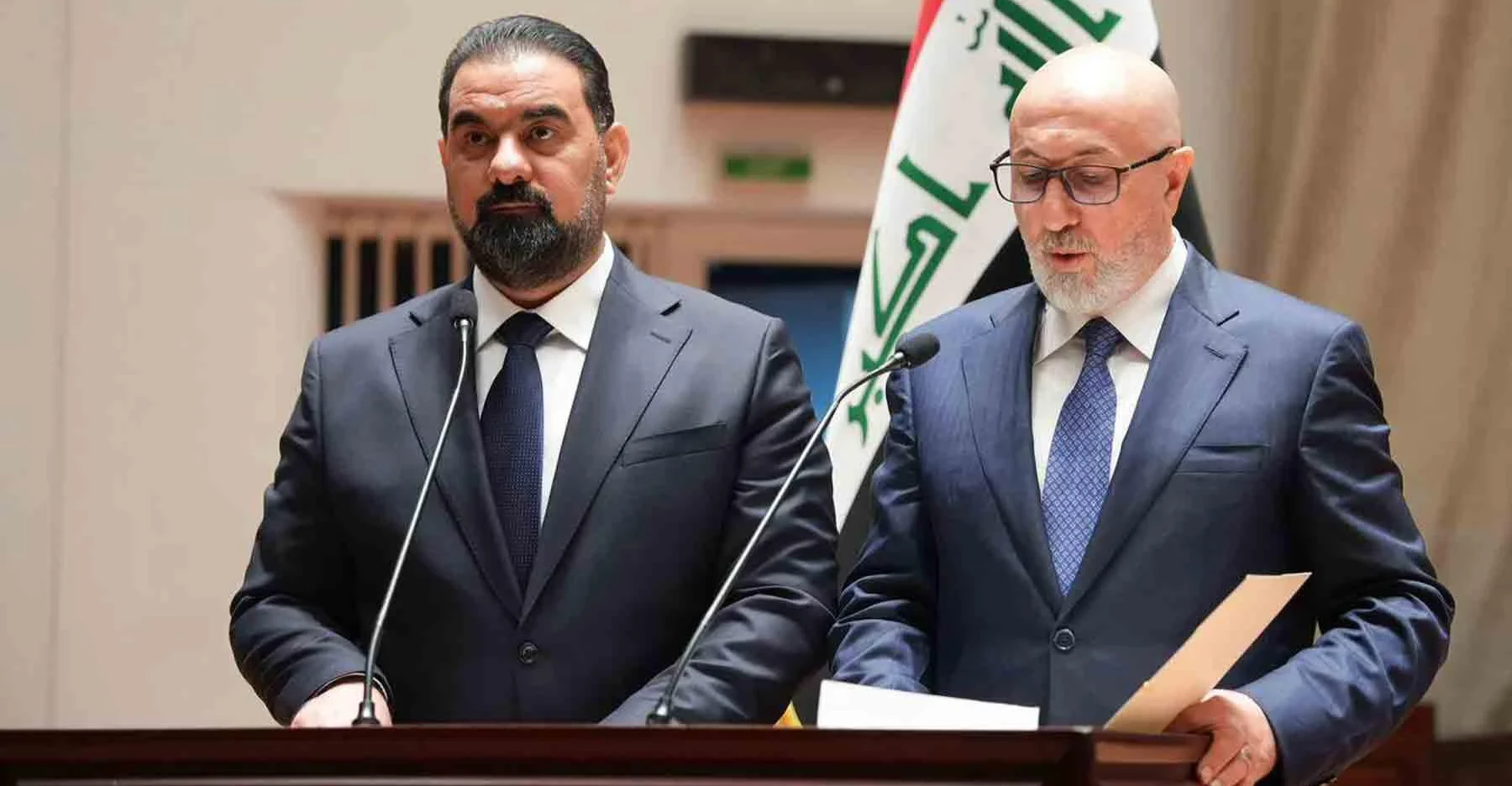 Iraq ended months of political paralysis by electing Nizar Amadi as the sixth president of the republic since 2003, but this also revealed deep structural divisions that threaten to prolong instability, with attention now turning to the more controversial battle over the premiership, according to a reading by the British website Middle East Online.
The British report , translated by Shafaq News Agency, began by mentioning statements by Amidi, who received 227 votes in a second round of voting after his election, in which he acknowledged the magnitude of the upcoming challenges and pledged to work according to the principle of “Iraq First”.
However, the report noted that this breakthrough came in a disputed session marked by boycotts from major political forces, including the Kurdistan Democratic Party and the State of Law Coalition, which reflects the “fragility of the political consensus,” as the Kurdistan Democratic Party criticized the House of Representatives for violating procedures, questioning whether the session had met the required legal quorum of 220 legislators.
According to the report, the dispute is not only about procedural concerns, but also reflects a deeper Kurdish rivalry, noting that the disagreement between the two Kurdish parties weakens Kurdish unity and limits their influence in Baghdad.
The report continued that these divisions come at a critical moment, as Iraq is undergoing a transitional movement amid the US-Israeli war on Iran, and Iraqi armed factions allied with Iran have launched attacks on US-linked targets, which in turn have led to retaliatory strikes that have killed Iraqis.
The report noted that, in light of these volatile conditions, the focus is now shifting towards the formation of the government, which represents the true weight of power within the Iraqi system, recalling that the constitution requires the new president to task, within 15 days, the nominee of the largest parliamentary bloc with forming a government, a process that must be completed within 30 days.
Nevertheless, the report noted that the definition of the “largest bloc” remains disputed, while the coordinating framework, despite having a parliamentary majority, is internally divided over who to nominate.
He explained that although the Coordination Framework had previously supported former Prime Minister Nouri al-Maliki, his nomination is facing local and international objections, including warnings from US President Donald Trump about possible consequences related to US support.
The report indicated that the crisis is exacerbated by the sectarian power-sharing system surrounding the presidency, the prime ministership, and the parliament, which creates overlapping levels of negotiation and veto power, while the Iraqi public is closely watching and betting with high expectations on a government capable of dealing with economic challenges, unemployment, and the failure of public services.
According to the British report, the danger lies in the continued division, especially within the Kurdish ranks and among the Shiite forces, which could prolong the stalemate that has left Iraq without a fully functioning government for about 150 days.
The report stated that Amidi’s election does not represent a new starting point, but rather a constitutional step that closes one chapter of the crisis and opens a more decisive and perhaps more volatile phase.
The report concluded by asking, “Whether Iraq moves toward a political consensus to produce a stable government, or slides back into prolonged paralysis, will depend on the ability of political actors to reconcile competing interests in a system increasingly strained by internal rivalries and external pressures.”
Shafaq.com