
Syrian Finance Minister from Washington: The 2026 budget ends the era of “printing money”.
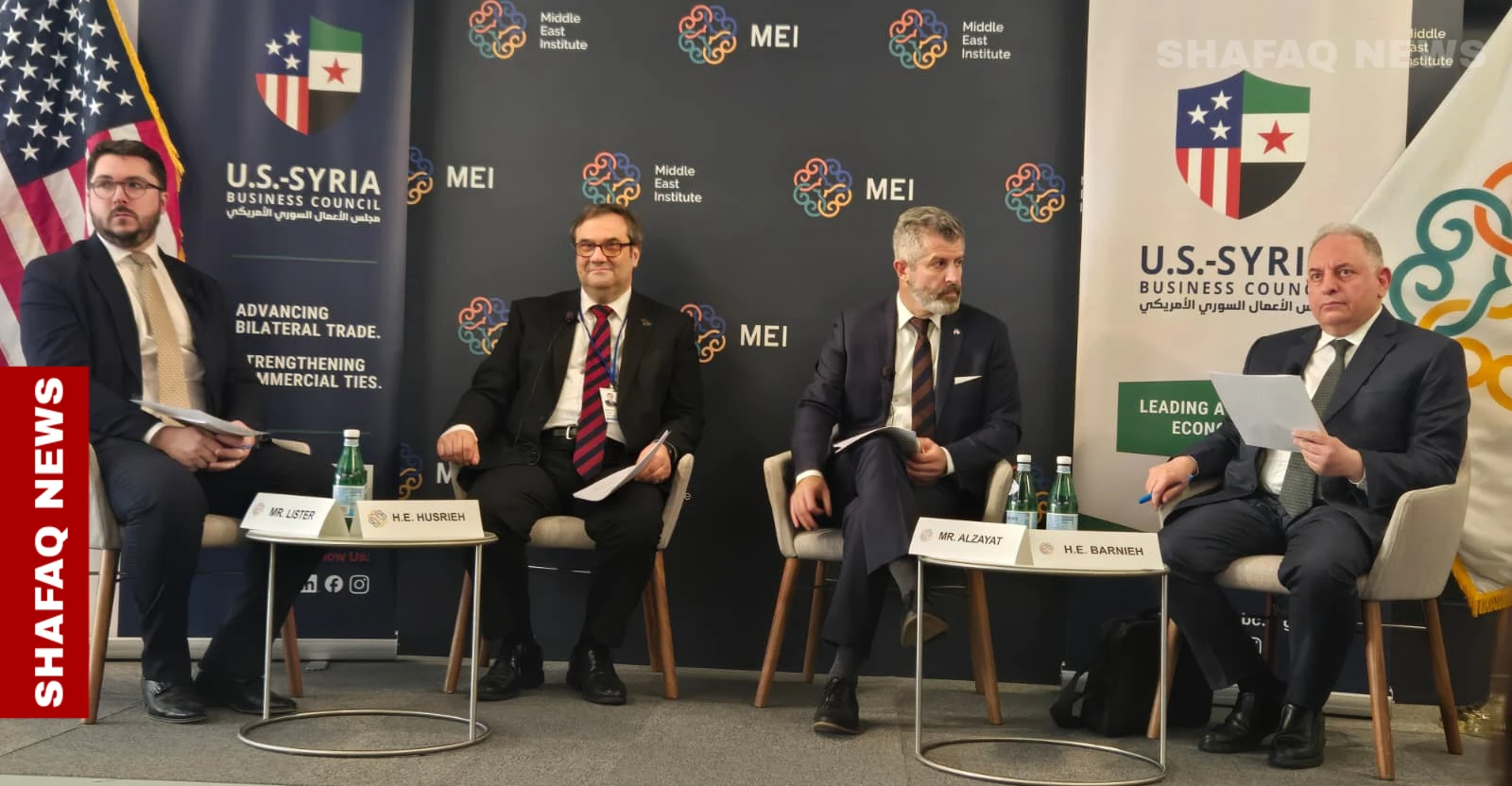 Syrian Finance Minister Yasser Barneh confirmed on Monday that Damascus has succeeded in establishing entirely new financial standards aimed at restoring international and local confidence in the national economy, noting that the 2026 budget represents a radical shift in the state’s priorities by focusing on education, health and reconstruction.
In reviewing the results of 2025 and the expectations for the new year, Barneh revealed, during a conference at the Middle East Institute in Washington, which was attended by a correspondent from Shafaq News Agency, unprecedented figures in the history of Syrian budgets, saying: “For the first time in the history of Syria, spending on education, health care and social services exceeds allocations for defense and security. We have allocated more than 40% of the 2026 budget to vital sectors that directly affect the lives of citizens.”
The minister explained that the government raised the minimum wage from $17 to $110, with salary increases in some professional sectors ranging from 400% to 700%, stressing that the goal is to bridge the cost of living gap despite the magnitude of the challenges.
Regarding the budget deficit, Barneh emphasized the ministry’s commitment to a policy of “strict fiscal discipline.” He announced that the government intends to finance the projected 2026 deficit (estimated at $1.842 billion) through sustainable financial instruments such as issuing bonds, rather than relying on “printing money” as was the practice in previous decades.
Regarding the 2025 results, Bernieh confirmed that the budget achieved a surplus that was used as a strong signal to international markets about the seriousness of the new fiscal policies.
On the subject of combating corruption, the minister stated that transparency is the primary weapon for building trust, pointing to the issuance of the “Citizen’s Budget” to simplify the figures for the public.
Barnieh pointed out that his ministry no longer issues laws or circulars “behind closed doors,” but rather adopts a public consultation approach with the business sector, academics, and civil society. He added, “My first task was to rebuild bridges with the business community to ensure that every financial decision taken is the product of a genuine partnership.”
In closing, Barnieh addressed a message to the American side and the international community, calling for a change in the stereotypical view towards Syria, saying: “We do not rely on promises but on concrete policies and reports issued by international institutions. Invest in Syria, as we are moving in the right direction to build a transparent and strong economy.”
According to the minister, the most prominent points of the 2026 budget are the minimum wage: raised to $110, and social spending: representing 40% of the budget (higher than security and defense).
He pointed out that the expected deficit is $1.84 billion (financed through bonds, not printing money). As for transparency, he said that there will be no financial legislation without consulting the private sector and civil society.
Shafaq.com