
Iraqi factions set a “red line” for resuming operations against US interests.
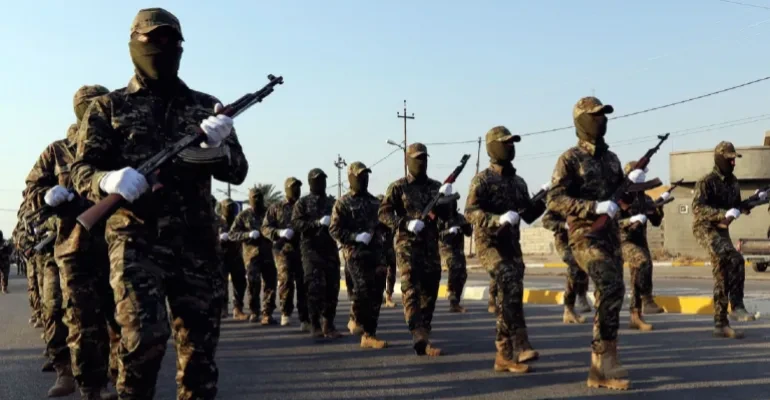 A leader in one of the armed factions confirmed on Monday that the decision to stop attacks against American interests inside Iraq and throughout the region is directly linked to the declared truce between Washington and Tehran, and any new targeting of Iran will witness an immediate and “large” return of targeting operations.
The leader told Shafaq News Agency, “This cessation is temporary and conditional, and any breach of the truce, especially in the event of a resumption of American-Israeli targeting of Iran, will be met with an immediate return to operations by the factions affiliated with the group, with the possibility of escalating them further than before.”
The leader, who asked not to be named, added that “the decision to halt operations at the present time is not related to any internal mediation or political pressure, and there is no interference from Iraqi political or governmental parties in this decision. What is happening is a tactical commitment related exclusively to the declared period of calm.”
He added that “the factions are closely monitoring the course of events, and their options remain open in case the field data changes. The next stage depends on the behavior of international and regional parties, and the continuation of calm is exclusively linked to the continued commitment to the truce and the avoidance of escalation.”
He pointed out that “the Resistance Coordination includes four main factions, namely Kataib Hezbollah, Harakat al-Nujaba, Kataib Sayyid al-Shuhada, and Ansar Allah al-Awfiya Movement.”
The head of the Design Alliance, Amer Al-Fayez, announced yesterday, Sunday, the success of the committee tasked by the Coordination Framework with negotiating with the armed factions to stop their operations against American interests .
Al-Fayez, one of the leaders of the Coordination Framework, told Shafaq News Agency that “the committee headed by the Secretary-General of the Badr Organization, Hadi al-Amiri, which was authorized by the Framework to negotiate with the armed factions, succeeded in its mission and obtained a conditional truce ,” explaining that “the truce stipulates that the factions stop their operations against American interests and diplomatic missions, in exchange for America and Israel committing not to escalate militarily and target the headquarters of the Popular Mobilization Forces and the factions .”
Last Tuesday, US President Donald Trump announced a two-week truce that included a halt to the war with Iran, before a round of negotiations began two days ago in Islamabad between the two sides.
The latest round of negotiations, which lasted more than 20 hours, came amid international hopes that a long-term truce could be established between Washington and Tehran, but the two delegations left early Sunday morning without any agreement, despite what was described as “the highest level of negotiating representation since 1979 “.
According to political leaks reported by multiple sources, the main points of contention revolved around three central issues (the Iranian nuclear program, especially the issue of uranium enrichment, the issue of Iranian regional influence, and the Strait of Hormuz), including fees and maritime passage.
A short while ago, the US blockade of the Strait of Hormuz began, seeking to intercept any ship arriving at or leaving Iranian ports, or any ship paying transit fees to Tehran.
Shafaq.com