
Discussion on Iraq in Washington: Issues of sovereignty, politics, and economics
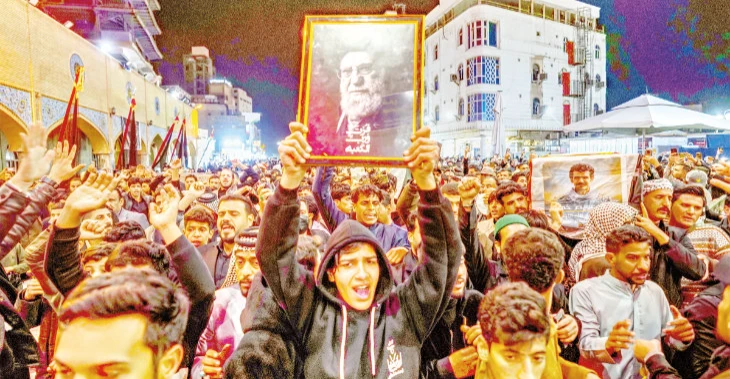 Iraq has once again found itself caught in the middle of a conflict between the United States, Israel, and Iran, which has exposed the political and economic weaknesses in Iraq that have existed since the 2003 invasion, especially after Tehran was subjected to an American-Israeli attack, and the Iraqi factions allied with it responded with attacks on American assets in Iraq, including the embassy, according to what was published by the American website “Washington Report”.
The American website published a report , translated by Shafaq News Agency, summarizing a virtual panel discussion in which experts on Iraqi affairs participated, including former US Ambassador to Baghdad Douglas Silliman, who currently heads the US Gulf States Institute in Washington. The discussion aimed to explore how the Iran-Iraq War would affect Iraq, which remains weak and struggling due to the 2003 invasion.
The report quoted Silliman as saying that the current reality reveals Iraq’s lack of true sovereignty, explaining that the country does not control its airspace, has non-governmental armed militias allied with a foreign state operating within its borders, and does not enjoy energy independence as it relies heavily on Iran for electricity and gas.
In addition, Silliman pointed out that Iraq is heavily dependent on the United States, as it is required to deposit all oil revenues in the Federal Reserve Bank of New York, recalling that US President Donald Trump recently threatened to withhold these funds if Iraq allowed former Prime Minister Nouri al-Maliki to return to power.
According to Silliman, as quoted by the Washington Report, this war should be a wake-up call for leaders in Baghdad to start taking sovereignty issues seriously, explaining that the problem is that corruption is still widespread, and many political parties and leaders are thinking about their own selfish interests rather than national interests.
The former US ambassador to Baghdad continued, saying that, for example, corrupt leaders hampered efforts to diversify Iraq’s oil exports through Jordan and Turkey and obstructed attempts to attract much-needed private sector development to diversify the country’s oil-dependent economy.
The report quoted him as saying that “this culture of corruption and the lack of a system that actually provides economic opportunities for Iraqis has turned into a real problem.”
The report noted the lack of land routes for the country’s oil exports, given that Iraqi oil is supposed to be transported almost entirely through the Strait of Hormuz, which Iran has effectively closed, noting that oil revenues account for about 90% of the country’s budget.
In the same virtual discussion, Luay Al-Khatib, an advisor at the American University in Iraq, warned, according to the report, that the Iraqi government would be forced to resort to severe austerity measures if the war continued, considering that it should reduce public sector salaries by no less than 50% or delay them.
He pointed out that if the government does not do this, Baghdad will have to print a huge amount of money, which will lead to increased inflation. He also noted that Baghdad must reduce the large subsidies on basic commodities such as fuel and electricity to protect the state budget and ease demand in case energy supplies become scarce.
He added that “without controlling the level of demand, it will be impossible to provide sustainable services.”
For his part, the report quoted Boston College political science assistant professor Mersin Alshammari as saying that most Iraqis, regardless of their religion or politics, “have no appetite” for war, adding that “Iraq is no stranger to being caught between Iran and Washington; this is essentially the story of Iraq after 2003, so it has some experience in maneuvering.”
According to Al-Shammari, “There is a large part of the Shiite population in Iraq who do not want to go to Iran’s aid, and who do not want to be part of this conflict at all,” adding that the reality indicates that some Shiites believe that the Islamic Republic regime has had a negative impact on Iraq’s development after 2003.
The report noted that the highest Shiite authority, Sayyid Ali al-Sistani, has always been skeptical of Iranian and American interference in Iraqi affairs, recalling that after Israel and the United States attacked Iran, he issued a statement that many described as moderate, expressing sympathy for the victims of the attack and condemning the war, but he did not attempt to mobilize the masses.
According to Al-Shammari, as reported in the report, this approach is typical of the Najaf school of Shiites, led by Sistani, explaining that Sistani is not silent as some believe, but rather “gives priority to the stability of society and the stability of the country,” and that Sistani and his followers are “political realists.”
The report quoted Al-Shammari as saying that if the Sistani religious authority had issued a fatwa after the assassination of Iranian Supreme Leader Ali Khamenei, stating that the Shiite community should rise up against the forces that assassinated him, then that would have “ended in a very violent and tragic war that would encompass the entire region and destroy the lives of millions of people.”
He continued, saying that “the important point is to try to find a solution that maintains stability and protects the peace that Iraqis have achieved with difficulty, at the present time.”
Shafaq.co