
23 years since the fall of Saddam’s regime… What has changed in Iraq?
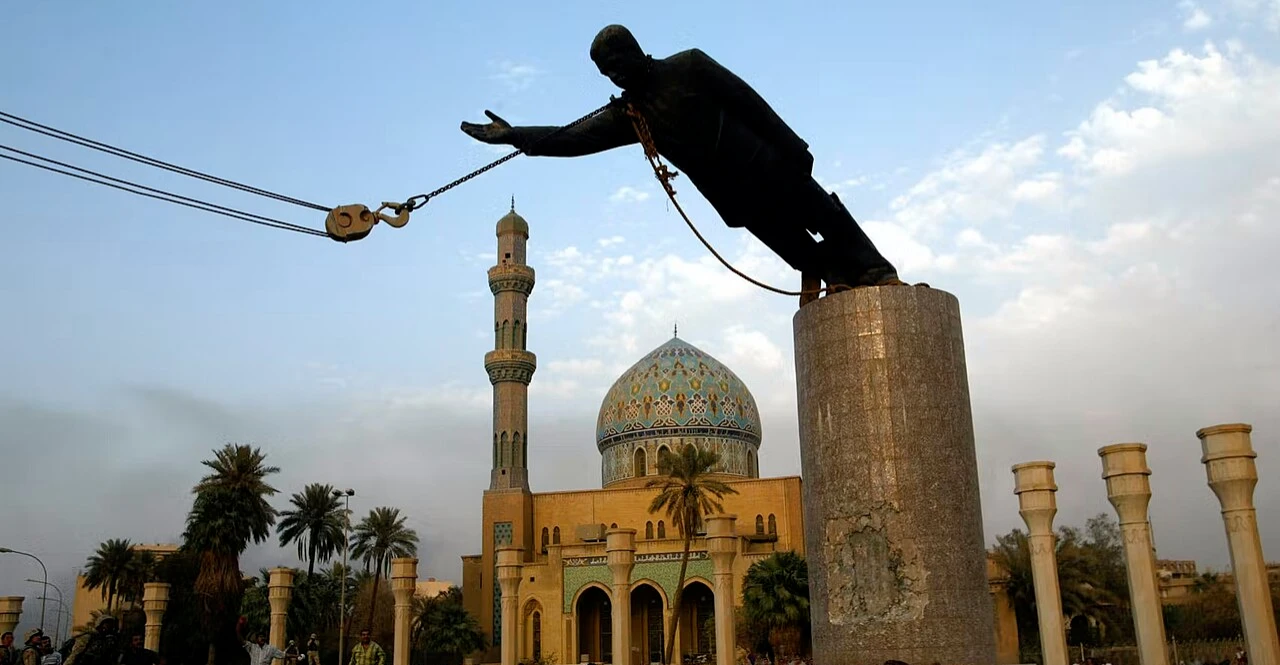 After 2003, Iraq witnessed unprecedented security, political, economic and media transformations following the fall of the Baath Party regime led by Saddam Hussein.
On April 9, 23 years ago, the entry of American tanks into the heart of the Iraqi capital, Baghdad, marked a pivotal moment in the country’s history, ending 35 years of dictatorial rule and opening the door to a new phase full of both challenges and opportunities.
Since that date, Iraqis have faced a major shock to their national security, as the Iraqi army and the Ministries of Defense and Interior were dissolved, causing a security vacuum that led to the emergence of armed groups and terrorist organizations such as “Al-Qaeda” and then “ISIS”.
On the political front, the country has transformed from a totalitarian regime to a fragile pluralism, reflected in the conflicts between political forces and the divisions within Iraqi society, which have affected national identity, according to politicians.
The economy was not spared from these transformations either. While it moved from the stage of the embargo – which lasted for about 13 years – to the stage of openness, it became almost entirely dependent on oil.
This rentier economy has made Iraqis hostages to the fluctuations of global markets and regional geopolitical factors, as recently happened in the aftermath of the US-Iranian war and the closure of the Strait of Hormuz, which is a vital artery for Iraqi oil exports.
As for the media, Iraq has witnessed a radical transformation from a unified central media to a diverse media space, both technically and in content, but it still suffers from professional weakness and sectarian political influence, which is confirmed by the academic researcher Dr. Haider Shallal in his reading of the Iraqi media scene.
Political reality
To assess the transformations that have occurred in the Iraqi political system after the fall of the dictatorship, politicians confirm that “the political scene after 2003 was a difficult transitional phase,” as described by Fahd al-Jubouri, a leader in the Wisdom Movement led by Ammar al-Hakim, which is part of the coordinating framework that brings together the ruling Shiite political forces in the country.
Al-Jubouri told Shafaq News Agency, “The events that took place after 2003 until today, concerning a political class, a political system, a popular class, and the general public, and since five election cycles in which a part of the Iraqi street participated in choosing its representatives, have been full of challenges, from a repressive dictatorial regime to an undisciplined democratic phase, which resulted in major problems and ongoing crises.”
According to al-Jubouri, the political groups that formed after the invasion led to sharp divisions that affected national identity. He said: “Part of the Iraqi people lost their national identity, and alternative identities emerged, sectarian, ethnic, and partisan, which were reflected on social media, which became an arena for denouncing opinions, between those who are described as ‘patriots’ and others who call the objector ‘tail’ or ‘agent’.”
He points out that this “natural” political chaos after years of repression needs to be gradually regulated to restore the state to its central role, explaining: “We are now halfway to formulating a basic equation, which is for the state to be the sponsor and responsible for all the details. There are political forces that support this concept, but on the other hand, there are other forces that see it in their interest to weaken the state and hide its existence.”
security transformations
On the security front, Iraq faced enormous challenges from the first day of the invasion, beginning with a major strategic mistake made by the American civilian governor, Paul Bremer, by dissolving the Iraqi army and the Ministries of Defense and Interior, and dismissing about 400,000 soldiers. According to military expert Ali Al-Maamari, this decision was the main reason for the chaos of the early years.
The architect explained to Shafaq News Agency that “Bremer’s decision was unjust, as it left Iraq in a state of security anxiety and instability, which led to the emergence of armed groups, sectarian terrorism, and national divisions,” stressing that “Iraq today needs a national policy that transcends ideology to guarantee its sovereignty and the country’s security and stability.”
The military expert points out that the emergence of organizations such as “Al-Qaeda” later on, and then “ISIS”, revealed the fragility of the security institutions at that stage, and led to an armed conflict that lasted for years, in which the Iraqi citizen had his share of fear and suffering.
He affirms that “the next stage is to impose the state on everyone, after turning the page on the challenges of (ISIS) and the security breakdown, so that the state can take its natural place in the parliamentary political system as stipulated in the constitution.”
Iraqi economy
From an economic standpoint, the Iraqi economy moved from a state of siege and sanctions after 2003 to a new phase, but it did not achieve the desired ambitions, according to economic expert Mustafa Al-Faraj.
Al-Faraj explained to Shafaq News Agency that “the economy has not only moved from a blockade to openness, but has become almost entirely dependent on oil,” noting that “any talk of reform is linked to three axes, starting with decoupling the budget from oil prices, then diversifying sources of income, and finally building real economic institutions.”
Although Iraq possesses enormous resources, it suffers from high unemployment, poor services, and financial fragility, according to the economist, who stressed that “the one-sided dependence on oil makes the economy hostage to price fluctuations and geopolitical factors, while the absence of other production sectors such as agriculture and industry has led to the inflation of the public sector at the expense of real production.”
Al-Faraj also points to another challenge arising from the opening up to imports after 2003, saying that “this opening up has whetted the appetite of traders and neighboring countries at the expense of the local product, which increases the fragility of the Iraqi economy despite the huge resources.”
Media transformations
The effects of the transformation 23 years ago were not limited to politics, security and the economy, but extended to include the media, which also witnessed a radical transformation after 2003, according to media professor Dr. Haider Shallal.
Shalal explained to Shafaq News Agency that “the media has moved from a centralized, directed approach to an open, pluralistic space, and the means have multiplied and the discourses have diversified, but it has suffered from weak professional and legislative organization, which has made the media an arena of conflict between political, religious and social forces, while affecting the credibility of the content.”
The development of technology has contributed to the rise of digital media and made the public an active participant in content creation, but the lack of professionalism and the spread of hate speech remain a challenge, according to Shalal, who stressed: “There is still a need to build a balanced, professional media that combines freedom and responsibility, and calms souls instead of terrifying them.”
Regional context
For his part, Essam Al-Faily, a professor of political science at Al-Mustansiriya University, presents a broader strategic vision that links all local transformations to regional and media transformations, saying that “the fall of the regime in 2003 was the beginning of the New Middle East project.”
Al-Faily told Shafaq News Agency that “the fall of the regime in 2003 contributed to the peaceful fall of multiple regimes, and created a large Israeli presence in the Arab region through new diplomatic relations, and also contributed to the depletion of the economic capabilities of countries due to internal conflicts.”
He concludes by saying that “the period after 2003 drew a new map of the Middle East, almost equivalent to the Sykes-Picot Agreement, and major economic and security projects will emerge in the next phase.”
Shafaq.com