
“Iran is a sinking ship”: A report details the distancing of its allies in Iraq.
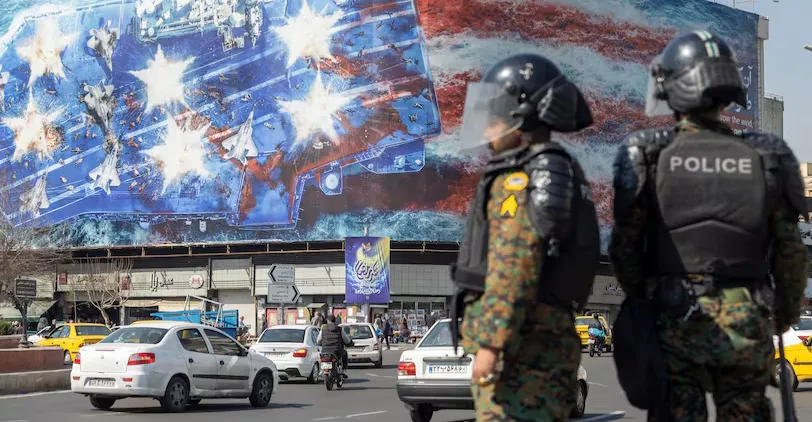 Analysts say that Tehran could become a “sinking ship” and be forced to loosen its grip on Iraqi politics, which is pushing pro-Iranian Iraqi leaders to distance themselves from it, especially given the weakness it suffers and the possibility that US President Donald Trump might resort to the option of war against it.
The Abu Dhabi-based English-language newspaper , The National , quoted Renad Mansour, a researcher at the British Chatham House think tank, as saying that some Iranian-backed officials in Iraq view Iran as a “sinking ship.” He explained that what they are witnessing is that Iraqi actors close to Iran realize that a sinking ship is not good for their power in Iraq, as stability for these groups means their economic prosperity, so they do not want to sacrifice that.
The newspaper noted in its report that the threat of American strikes comes as Iraq is trying to form a new government, pointing out that Iran usually has great influence over whoever assumes the premiership in Baghdad, but there are indications that things have changed.
The report quoted Michael Knights, a researcher at the American company Horizon Engineering, as saying that “they have to choose an elected prime minister in the midst of this and they have no idea whether the Islamic Republic will still exist by the time that person is appointed,” adding that what is happening will force “Iran’s friends to choose someone allied with the West and the Arab world.”
While the report noted Iran’s suffering since the Gaza war and the attacks against its facilities last summer by the United States and Israel, it quoted Chatham House researcher Galip Dalay as saying that the Iranian regime’s position in the region has become weak and its ambitions have declined throughout the region, explaining that “for Middle Eastern leaders, the threats have changed, and the biggest risks are now an expansionist and aggressive Israel, and the chaos of an Iranian state that is likely to collapse.”
The report quoted Dalay as saying that if the United States decides to launch strikes against Iran, Tehran’s influence may decline further, along with that of its regional proxies. He explained that the result could be that “Iranian influence, which is still strong in Iraq, may become weaker, Hezbollah in Lebanon will become weaker, and the Houthis in Yemen will also lack a patron.”
He adds that if Iran is attacked, its proxy groups could launch attacks on US military bases – although there were no such counterstrikes during last year’s war.
As for Mansour, if “the scope of the air strikes is similar to the June War, then Iraqi resistance groups supported by Iran, such as (Kataib Hezbollah), could attack US allies or bases in Iraq and the region.”
The report quoted Bente Schiller, a researcher at the Heinrich Böll Foundation, as saying that the countries hosting these military bases could also become a target, explaining that “if the regime in Tehran believes it has nothing to lose, it is likely to focus its retaliation on the American bases in the host countries,” adding that “as a result, Iran may consider these countries legitimate targets as well.” This is why regional countries are pushing for a diplomatic solution.
According to Schiller, the region fears that unrest and instability in Iran could harm its own interests, noting that Tehran has previously threatened to close the Strait of Hormuz if it is attacked, a move that would choke off a fifth of the world’s oil flows.
The report quoted Schiller as saying, “It is a weak point in terms of the economy, because war would increase the risks for this crucial point in international trade.”
Shafaq.com