
The collapse of the Iranian currency: a crisis that shakes markets and confounds Kurdistan’s traders.
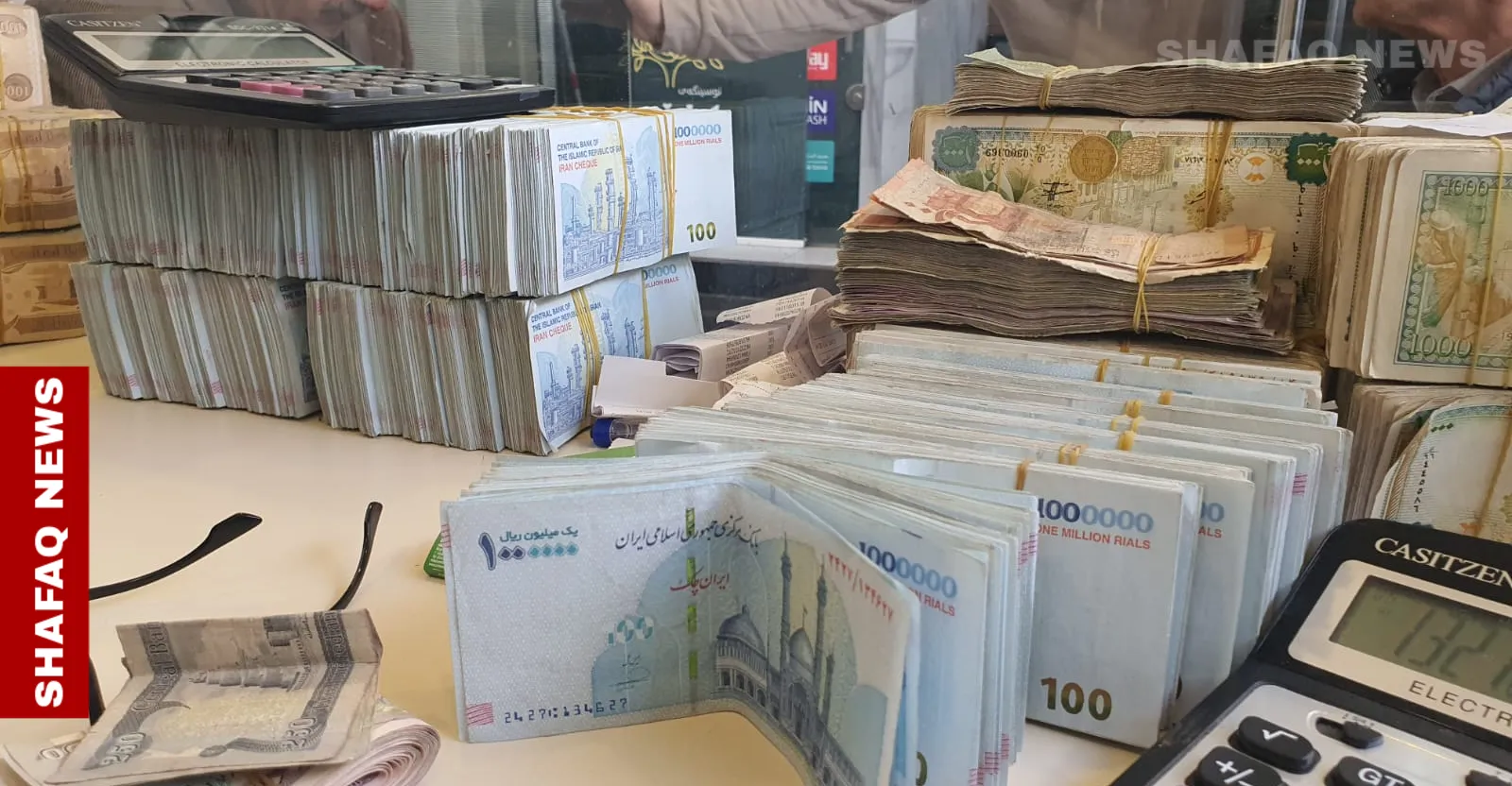 The Iranian rial has been experiencing a sharp decline for days, the most severe in years, in a rapid downward wave that has cast a shadow over the markets of Iraqi Kurdistan, especially the banking sector, which relies heavily on the movement of the toman in daily buying and selling.
According to a Shafaq News Agency correspondent in Sulaymaniyah, the price of 100 US dollars reached about 12 million and 150 thousand Iranian Tomans, an unprecedented level that prompted many traders to recalculate their accounts.
Kawa Yahya, a currency trader in Sulaymaniyah, told Shafaq News that the recent decline was unexpected, stressing that demand for the dollar inside Iran rose exceptionally following the escalation of tensions between Tehran and both the United States and Israel, which put direct pressure on the local currency.
Yahya points out that what is happening today cannot be explained by economic standards alone, and in his opinion, “the political factor is the main driver of the current decline,” expressing surprise that a country with such broad local self-sufficiency as that achieved in Iran cannot prevent this decline in its currency.
He adds that many currency traders in the Kurdistan Region have suffered significant losses as a result of the rapid decline, especially those who had been holding large quantities of Toman during the past period.
In the context of a broader economic analysis, economist Ismail Mohammed reveals to Shafaq News Agency that the current crisis has complex roots, starting from the outside and not ending at the inside.
The expert confirms that the deterioration of relations between Iran and the United States and European countries has put the local currency under direct political pressure, saying that “any disturbance between a country and America or Europe is quickly reflected in the value of its currency, and the Iranian rial is no exception.”
But at the same time, he points to the existence of concurrent internal reasons, represented by a package of economic decisions that the Iranian government is preparing to implement at the beginning of next year, most notably raising fuel prices and increasing the prices of a number of local goods in exchange for government plans to raise employee salaries, which are measures that he believes will double the pressure on the currency and open the door to a new wave of inflation.
The agency’s correspondent reports that the currency exchange markets in Sulaymaniyah, Halabja and Garmian have witnessed a clear state of confusion over the past two days, as a number of traders have reduced their transactions in Toman while waiting for the market to stabilize, while others reported a decline in demand from customers who usually relied on the Iranian currency for daily transfers or for purchasing goods coming from the Iranian side.
This decline comes in the context of a long downward trend witnessed by the Iranian currency during 2025. According to a quick tracking, the year began with a price of approximately 4.8 million tomans per 100 dollars, then it rose to about 7.5 million tomans in the middle of the year following a new round of US sanctions. With the fall, and with the increase in regional tensions, the price exceeded 10 million tomans, reaching 11.15 million tomans in December, which is the lowest level in more than ten years.
Analysts agree that continued political tension and the absence of radical economic solutions could push the currency down further in the coming weeks unless Tehran intervenes with effective steps to curb the decline.
Shafaq.com